-
New CAPLYTA® (lumateperone) Phase 3 analyses evaluating efficacy in achieving remission in adjunctive major depressive disorder (aMDD) to be presented
-
SPRAVATO® (esketamine) effects on anhedonia in treatment-resistant depression (TRD) – Phase 3 data post-hoc analyses to be presented
-
Comparative tolerability of adjunctive seltorexant vs. adjunctive quetiapine XR in major depressive disorder (MDD) with insomnia symptoms – new Phase 3 metabolic analyses will also be presented
TITUSVILLE, N.J. (January 13, 2026) — Johnson & Johnson (NYSE: JNJ) announced today that 11 abstracts featuring new data on its robust portfolio and pipeline in neuropsychiatry will be presented at the 64th Annual Meeting of the American College of Neuropsychopharmacology (ACNP), held from January 12-15, in Nassau, Bahamas. Presentations include the latest research from across the Company’s neuropsychiatry portfolio, including major depressive disorder (MDD) and treatment-resistant depression (TRD), as well as preclinical and translational neuropsychiatric research.
“At Johnson & Johnson, we are tackling the greatest unmet needs for patients living with depression, schizophrenia and bipolar disorder – with the ultimate goal of remission from disease,” said Bill Martin, Ph.D., Global Therapeutic Area Head, Neuroscience, Johnson & Johnson Innovative Medicine. “Our data at ACNP this year showcases how we are boldly advancing our portfolio, from clinical findings on remission and tolerability to preclinical research on novel mechanisms and AI-driven precision tools, reflecting our commitment to redefining standards of care.”
Key presentations include:
-
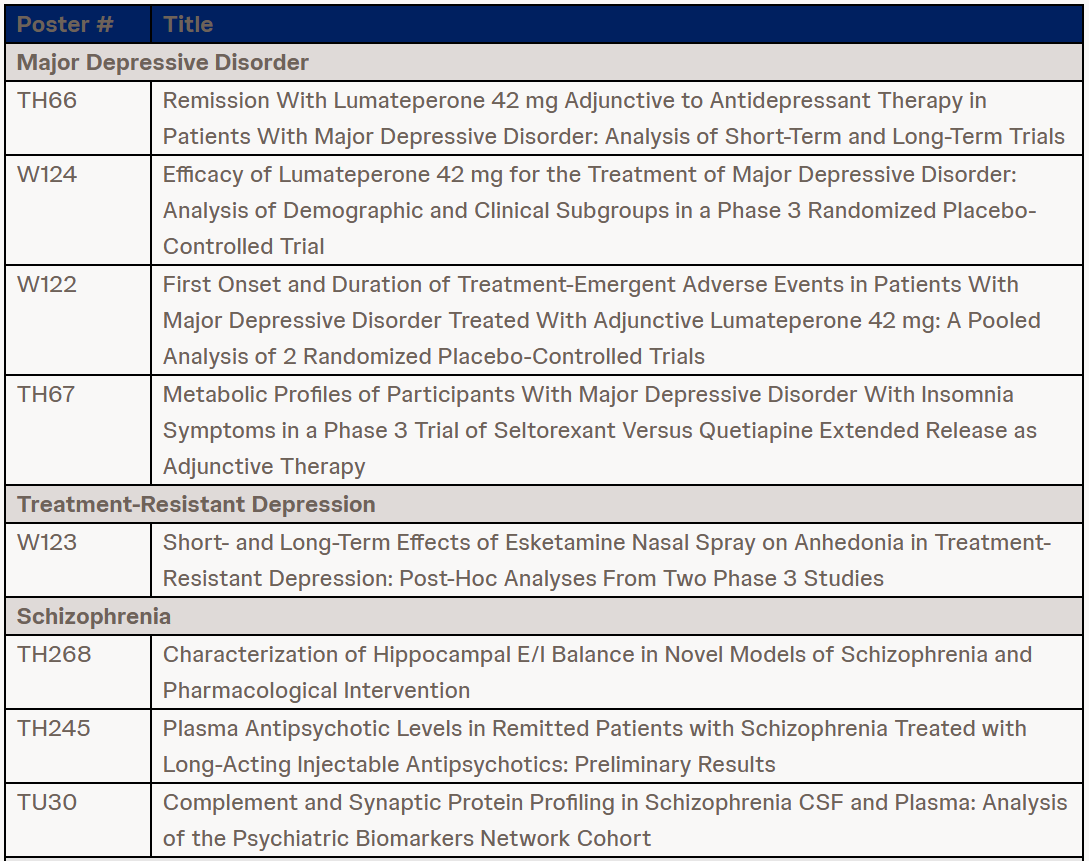
A new analysis of Phase 3 clinical trials evaluating the efficacy of CAPLYTA® (lumateperone) in combination with antidepressants for remission of MDD symptoms in adults (Poster TH66).1
-
New metabolic analyses of Phase 3 data evaluating the tolerability of seltorexant adjunctive to SSRI/SNRI, an investigational first-in-class therapy, compared to adjunctive quetiapine extended release (XR) in patients with MDD with insomnia symptoms (Poster TH67).2
-
Findings from post-hoc analyses of two Phase 3 studies, TRANSFORM-2 and SUSTAIN-2, exploring the effects of SPRAVATO® (esketamine) CIII nasal spray on anhedonia in patients with TRD (Poster W123).3
-
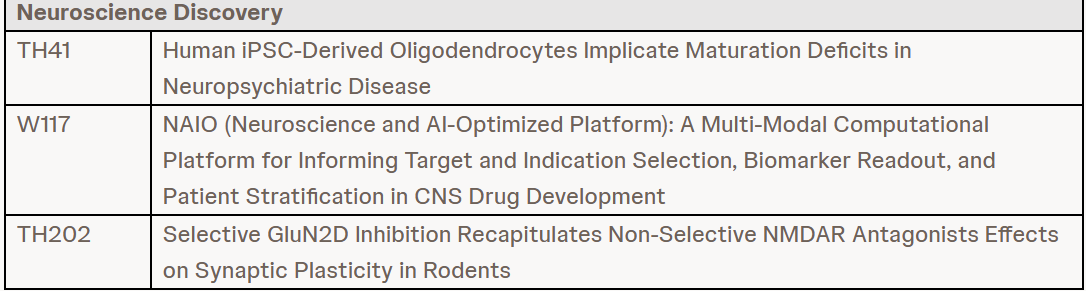
Preclinical and translational research showcasing novel AI platforms for precision medicine (Poster W117), investigating biology associated with neuropsychiatric diseases (Poster TU30), and early-stage work on new therapeutic mechanisms for depression (Poster TH202).4,5,6
Johnson & Johnson will present the following posters at the ACNP meeting on January 14 at 5:00 – 7:00 p.m. ET and January 15 at 5:00 – 7:00 p.m. ET in the Exhibit Halls:
ABOUT MAJOR DEPRESSIVE DISORDER (MDD)
MDD is one of the most common psychiatric disorders and a leading cause of disability worldwide, impacting an estimated 332 million people – or about 4 percent of the population.7,8 In 2023, approximately 22 million adults in the U.S. had at least one major depressive episode.9 While depression is typically treated with a “one-size-fits-all” approach, no two cases are the same. MDD is a complex, heterogeneous disorder involving multiple regions of the brain and presenting with as many as 256 unique symptom combinations.10,11 As a result, responses to treatment vary widely. Only 1 in 3 patients reach remission with their first antidepressant – and rates continue to decline further with each subsequent treatment, leaving many to spend years cycling through multiple treatments trying to find complete, sustained symptom relief.12 Moreover, MDD is a risk factor for the development and worsening of a range of comorbidities, illustrating the importance of integrating mental and general health care.13
MDD often includes sleep disturbances such as insomnia or hypersomnia, with approximately 60 percent of MDD patients experiencing clinically relevant insomnia symptoms despite being on an SSRI/SNRI.14 Disturbed sleep and insomnia symptoms have a significant impact on a patient’s quality of life and exacerbate the risk of depressive relapse and suicide.15,16
Approximately one-third of adults with MDD will not respond to oral antidepressants alone and are considered to have treatment-resistant depression (TRD), which is often defined as inadequate response to two or more oral antidepressants that were administered at an adequate dose for an adequate duration.17,18 TRD has a significant negative impact on the lives of those affected and has one of the highest economic burdens of all psychiatric disorders.18 Patients often cycle through multiple oral medications, waiting 4-6 weeks for potential relief.19 Based on the STAR*D study, after trying their third oral antidepressant, approximately 86 percent of patients do not achieve remission.19
About CAPLYTA® (lumateperone)
CAPLYTA® 42 mg is an oral, once daily atypical antipsychotic approved in adults as an adjunctive therapy with antidepressants for major depressive disorder (MDD), schizophrenia, and depressive episodes associated with bipolar I or II disorder (bipolar depression), as monotherapy, and as adjunctive therapy with lithium or valproate. While the mechanism of action of CAPLYTA® is unknown, the efficacy of CAPLYTA® could be mediated through a combination of antagonist activity at central serotonin 5-HT2A receptors and partial agonist activity at central dopamine D2 receptors.
About Seltorexant
Seltorexant, an investigational first-in-class therapy, is a selective antagonist of the human orexin-2 receptor currently being developed as an adjunctive treatment for adults with MDD with insomnia symptoms. Seltorexant selectively antagonizes the orexin-2 receptors, potentially improving mood symptoms associated with depression and restoring sleep without next-day sedation in patients with depression.20 When orexin-2 receptors are stimulated for too long or at inappropriate times, their activation can cause hyperarousal manifestations, including insomnia and excessive cortisol release, which may contribute to depression and insomnia.21,22 Seltorexant is the only investigational therapy under study for the treatment of MDD that is believed to work by normalizing the overactivation of the orexin-2 receptors, thereby targeting the underlying biology that contributes to depression and insomnia symptoms.
ABOUT SPRAVATO®
SPRAVATO® (esketamine) CIII nasal spray is approved by the U.S. Food and Drug Administration alone or in conjunction with an oral antidepressant for adults with MDD when they have inadequate response to at least two oral antidepressants (TRD) and depressive symptoms in adults with major depressive disorder with acute suicidal ideation or behavior in conjunction with an oral antidepressant. It is a non-selective, non-competitive antagonist of the N-methyl-D-aspartate (NMDA) receptor and is believed to work differently than traditional antidepressants by acting on a pathway in the brain that affects glutamate. The mechanism by which esketamine exerts its antidepressant effect is unknown. To date, SPRAVATO® has been approved in 79 markets and administered to more than 150,000 patients worldwide.
About Johnson & Johnson
At Johnson & Johnson, we believe health is everything. Our strength in healthcare innovation empowers us to build a world where complex diseases are prevented, treated, and cured, where treatments are smarter and less invasive, and solutions are personal. Through our expertise in Innovative Medicine and MedTech, we are uniquely positioned to innovate across the full spectrum of healthcare solutions today to deliver the breakthroughs of tomorrow and profoundly impact health for humanity.
Footnotes:
1 Bhagwagar Z, Chen C, Durgam S et al. Remission With Lumateperone 42 mg Adjunctive to Antidepressant Therapy in Patients With Major Depressive Disorder: Analysis of Short-Term and Long-Term Trials. 2026 ACNP Annual Meeting; January 12-15, 2026. Poster TH66.
2 Canuso C, Drevets W.C., Flossbach Y et al. Metabolic Profiles of Participants With Major Depressive Disorder With Insomnia Symptoms in a Phase 3 Trial of Seltorexant Versus Quetiapine Extended Release as Adjunctive Therapy. 2026 ACNP Annual Meeting; January 12-15, 2026. Poster TH67.
3 Bossie C, Cutler A.J., Drevets W.C. et al. Short- and Long-Term Effects of Esketamine Nasal Spray on Anhedonia in Treatment-Resistant Depression: Post-Hoc Analyses From Two Phase 3 Studies. 2026 ACNP Annual Meeting; January 12-15, 2026. Poster W123.
4 Anticevic A, Demsar J, Helmer M et al. NAIO (Neuroscience and AI-Optimized Platform): A Multi-Modal Computational Platform for Informing Target and Indication Selection, Biomarker Readout, and Patient Stratification in CNS Drug Development. 2026 ACNP Annual Meeting; January 12-15, 2026. Poster W117.
5 Triana-Baltzer G et al. Complement and Synaptic Protein Profiling in Schizophrenia CSF and Plasma: Analysis of the Psychiatric Biomarkers Network Cohort. 2026 ACNP Annual Meeting; January 12-15, 2026. Poster TU30.
6 Ahnaou A, Almenar J, Balana B et al. Selective GluN2D Inhibition Recapitulates Non-Selective NMDAR Antagonists Effects on Synaptic Plasticity in Rodents. 2026 ACNP Annual Meeting; January 12-15, 2026. Poster TH202.
7 World Health Organization. Mental disorders. Accessed January 2026. https://www.who.int/news-room/fact-sheets/detail/mental-disorders
8 National Alliance on Mental Health. Mental health by the numbers. Accessed January 2026. https://www.nami.org/about-mental-illness/mental-health-by-the-numbers/#:~:text=Millions%20of%20people%20are%20affected,represents%201%20in%205%20adults
9 Key substance use and mental health indicators in the United States: results from the 2023 national survey on drug use and health. Center for Behavioral Health Statistics and Quality, Substance Abuse and Mental Health Services Administration. Published July 2024. Accessed January 2026. https://www.samhsa.gov/data/report/2023-nsduh-annual-national-report
10 Su YA and Si T. Progress and challenges in research of the mechanisms of anhedonia in major depressive disorder. Gen Psychiatr. 2022;35:e100724. doi: 10.1136/gpsych-2021-10072
11 Pandya M, et al. Where in the Brain Is Depression? Curr Psychiatry Rep. 2012;14:634–642. doi: 10.1007/s11920-012-0322-7
12 Rush AJ, Trivedi MH, Wisniewski SR, et al. Acute and longer-term outcomes in depressed outpatients requiring one or several treatment steps: a STAR*D report. Am J Psychiatry. 2006 Nov;163(11):1905-17. doi: 10.1176/ajp.2006.163.
13 Arnaud AM, Brister TS, Duckworth K, et al. Impact of major depressive disorder on comorbidities: a systematic literature review. J Clin Psychiatry. 2022;83(6):21r14328.
14 Ohayon MM, Roth T. Place of chronic insomnia in the course of depressive and anxiety disorders. J Psychiatr Res. 2003;37(1):9-15. doi:10.1016/S0022-3956(02)00052-3
15 Taddei-Allen P. Economic Burden and Managed Care Considerations for the Treatment of Insomnia. AJMC. Updated April 12, 2020. Accessed January 2026. https://www.ajmc.com/view/economic-burden-and-managed-care-considerations-for-the-treatment-of-insomnia
16 Ağargün MY, Kara H, Solmaz M. Sleep disturbances and suicidal behavior in patients with major depression. J Clin Psychiatry. 1997;58(6):249-51.
17 National Institute of Mental Health. Major Depression. Accessed January 2026. https://www.nimh.nih.gov/health/statistics/major-depression
18 Zhdanava M, Pilon D, Ghelerter I, et al. The prevalence and national burden of treatment-resistant depression and major depressive disorder in the United States. J Clin Psychiatry. 2021;82(2):20m13699. doi: 10.4088/JCP.20m13699
19 Sanacora G, Zarate C, Krystal J, et al. Targeting the glutamatergic system to develop novel, improved therapeutics for mood disorders. Nat Rev Drug Discov. 2008;7(5):426-437. doi:10.1038/nrd2462
20 Recourt K, de Boer P, Zuiker R, et al. The selective orexin-2 antagonist seltorexant (JNJ-42847922/MIN-202) shows antidepressant and sleep-promoting effects in patients with major depressive disorder [published correction appears in Transl Psychiatry. 2019 Oct 2;9(1):240. doi: 10.1038/s41398-019-0585-4].
21 Nollet M, Leman S. Role of orexin in the pathophysiology of depression: potential for pharmacological intervention. CNS Drugs. 2013;27(6):411-422. doi:10.1007/s40263-013-0064-z
22 Brooks S, Jacobs GE, de Boer P, et al. The selective orexin-2 receptor antagonist seltorexant improves sleep: An exploratory double-blind, placebo controlled, crossover study in antidepressant-treated major depressive disorder patients with persistent insomnia. J Psychopharmacol. 2019;33(2):202-209. doi:10.1177/0269881118822258