-
Approval based on unprecedented Phase 3 data demonstrating statistically significant improvements in progression‑free survival and overall survival versus standard of care regimens
-
83.3% of patients were alive at three years, indicating durable clinical benefit
HORSHAM, Pa. (March 5, 2026) – Johnson & Johnson (NYSE:JNJ), a worldwide leader in multiple myeloma therapies, today announced that the U.S. Food and Drug Administration (FDA) approved TECVAYLI® (teclistamab-cqyv) plus DARZALEX FASPRO® (daratumumab and hyaluronidase-fihj) for the treatment of adults with relapsed or refractory multiple myeloma (RRMM) who have received at least one prior line of therapy, including a proteasome inhibitor and an immunomodulatory agent.1 TECVAYLI® and DARZALEX FASPRO® work synergistically to prime and activate the immune system to eradicate myeloma cells that express the BCMA protein.1 This approval offers a potential new standard of care (SOC) as early as second line and brings a novel treatment approach for the 40% of patients with multiple myeloma who experience disease relapse.2
Multimedia assets for media are available here.
Perspectives on Expanding Multiple Myeloma Treatment Options
“This new treatment option can redefine how we approach RRMM treatment by giving healthcare providers a regimen with improvement in PFS and OS and a well-characterized safety profile,” said Dr. Luciano J. Costa, Professor of Multiple Myeloma and Director of the Multiple Myeloma Research and Treatment Program at the University of Alabama at Birmingham, and Primary Investigator of MajesTEC-3*. “The option to use this regimen as early as second line is particularly important because patients with RRMM often experience multiple relapses and reduced responsiveness to therapy over time, which makes earlier treatment with the most effective therapies critical. In addition, the steroid-sparing approach may reduce toxicity and improve tolerability.”
“There is a critical need to expand community-based treatment options for multiple myeloma patients, allowing them to receive care closer to home while respecting their individual treatment preferences,” said Heather Ortner Cooper, President & CEO of the International Myeloma Foundation**. “This approval enhances the therapeutic landscape, giving oncologists diverse options to personalize treatment plans for each patient.”
“As the leader in hematology, we have a proud history of transforming the treatment landscape for multiple myeloma. This approval represents another pivotal milestone in improving outcomes for patients living with this disease, with a unique regimen accessible to patients across all practice settings,” said Imran Khan, M.D., Ph.D., Vice President, U.S. Hematology Medical Affairs, Johnson & Johnson. “The FDA approval of TECVAYLI plus DARZALEX FASPRO adds a powerful new treatment option to our multiple myeloma portfolio, moving us closer to our ambition of one day curing this disease.”
Unprecedented MajesTEC-3 Study Results
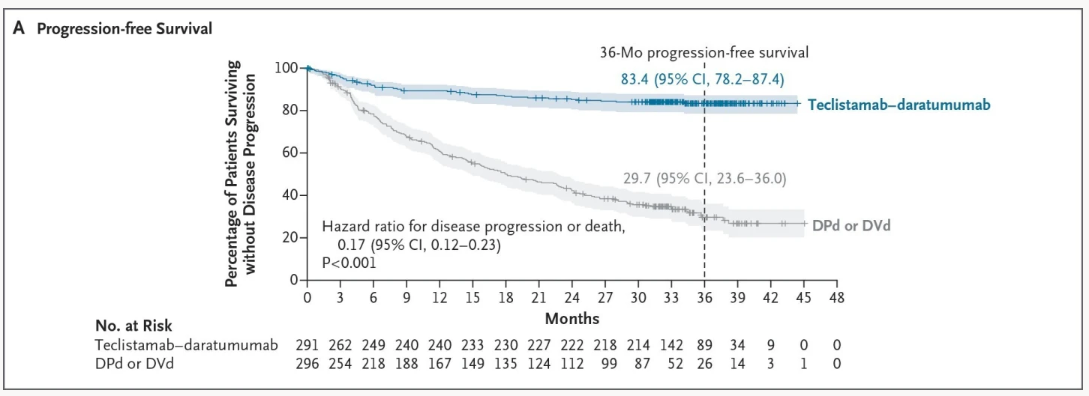
The approval is based on data from the Phase 3 MajesTEC-3 study, an ongoing, Phase 3 randomized study evaluating the safety and efficacy of teclistamab plus daratumumab versus investigator’s choice of daratumumab and dexamethasone with either pomalidomide or bortezomib in patients with RRMM who have received at least one prior line of therapy. TECVAYLI® in combination with DARZALEX FASPRO® demonstrated statistically significant improvements in PFS and OS in patients with RRMM compared to standard treatment after a median follow-up of three years in patients with RRMM. Results show an 83% reduction in the risk of disease progression or death compared to standard regimens (hazard ratio [HR], 0.17; 95 percent confidence interval [CI], 0.12-0.23; P<0.0001).3 The three-year PFS rate was 83% compared to 30% in the control arm, underscoring a durable benefit.3 The results were presented in December 2025 as a late-breaking oral presentation at the American Society of Hematology (ASH) Annual Meeting with simultaneous publication in The New England Journal of Medicine.
Significant improvements compared to SOC were observed across key secondary endpoints, including treatment response rates, minimal residual disease (MRD)-negativity, OS, and time to worsening of symptoms – revealing the impact of the regimen across varied patient measures.3 TECVAYLI® plus DARZALEX FASPRO® showed higher rates of overall response (ORR) (89.0% vs. 75.3%; OR, 2.65; 95% CI, 1.68-4.18), complete response (≥CR) (81.8% vs. 32.1%; odds ratio [OR], 9.56; 95% CI, 6.47-14.14), and MRD-negativity (58.4% vs. 17.1%; OR, 6.78; 95% CI, 4.53-10.15, P<0.0001; evaluable rate of 89.3% vs. 63.0%) at three-years follow-up.3 OS favored TECVAYLI® plus DARZALEX FASPRO® (HR, 0.46; 95% CI, 0.32-0.65; P<0.0001) across all prespecified subgroups. At three years, OS rates were 83.3% and 65.0% for the TECVAYLI® plus DARZALEX FASPRO® arm and the control arm, respectively.3
In the MajesTEC-3 study, TECVAYLI® plus DARZALEX FASPRO® and SOC comparators had similar rates of Grade 3/4 (95.1% vs. 96.6%) treatment-emergent adverse events (TEAE).3 Most Grade 3/4 events were due to cytopenias and infection.3 Infections were observed with TECVAYLI® and DARZALEX FASPRO® (any grade, 96.5%; Grade 3/4, 54.1%) and DPd/DVd control (any grade 84.1%; Grade 3/4 43.4%). Grade 3 or higher infections with TECVAYLI® and DARZALEX FASPRO® declined after the first 6 months of treatment consistent with use of established immunoglobulin supplementation and infection prophylaxis protocols, along with switch to monthly dosing.3 Cytokine release syndrome occurred in 60.1% of patients; all cases were Grade 1/2, did not lead to treatment discontinuation and were effectively managed using standard guidelines.3 Immune effector cell-associated neurotoxicity syndrome was rare and occurred in 1.1% of patients.3 Serious adverse events occurred in 70.7% of patients compared to 62.4% of patients treated with the control regimen, while treatment discontinuations due to adverse events were low (4.6% vs. 5.5%).3 Grade 5 TEAEs were 7.1% and 5.9% with TECVAYLI® plus DARZALEX FASPRO® and DPd/DVd control, respectively.3
The FDA proactively selected the teclistamab MajesTEC-3 supplemental Biologics License Application (sBLA) to participate in the Commissioner’s National Priority Voucher (CNPV) Pilot Program as it aligns with the program’s priority to deliver more innovative therapies for American people. The FDA also granted the application Breakthrough Therapy Designation and Real-Time Oncology Review.
Access to TECVAYLI® plus DARZALEX FASPRO®
Johnson & Johnson offers comprehensive access and support information and resources to assist patients in gaining access to our multiple myeloma therapies. Our patient support program, TECVAYLI® withMe‡, is available to provide personalized support to help patients start and stay on their Johnson & Johnson medicines once the clinical decision has been made to prescribe. TECVAYLI® withMe helps providers support their patients by verifying patients’ insurance coverage, providing information on Prior Authorization and Appeals processes and educating on reimbursement processes. Patients can connect to TECVAYLI® withMe to receive cost support, regardless of insurance type, free, personalized one-on-one support from a Care Navigator, and resources and community connections. Learn more at TECVAYLI.com or by calling 833-JNJ-wMe1 (833-565-9631).
About MajesTEC-3
MajesTEC-3 is an ongoing, Phase 3 randomized study evaluating the safety and efficacy of teclistamab plus daratumumab versus investigator’s choice of daratumumab and dexamethasone with either pomalidomide or bortezomib in patients with relapsed/refractory multiple myeloma who have received at least one prior line of therapy. The primary endpoint is PFS and secondary endpoints include complete response or better, overall response rate, minimal residual disease negativity, overall survival, time to worsening of symptoms (MySIm-Q), and safety. The MajesTEC-3 study is a part of the MajesTEC clinical program, which includes exploring the potential of TECVAYLI® as a combination regimen.4 It is the first randomized Phase 3 trial using a bispecific antibody in relapsed/refractory multiple myeloma and confirmatory trial after the initial FDA approval.
About TECVAYLI®
TECVAYLI® (teclistamab-cqyv) is a first-in-class, bispecific T-cell engager antibody therapy that uses innovative science to activate the immune system by binding to the CD3 receptor expressed on the surface of T-cells and to the B-cell maturation antigen (BCMA) expressed on the surface of multiple myeloma cells and some healthy B-lineage cells. TECVAYLI® received accelerated approval from the U.S. FDA in October 2022 as an off-the-shelf (or ready-to-use) antibody that is administered as a subcutaneous treatment for adult patients with relapsed or refractory multiple myeloma (RRMM) who have received at least four prior lines of therapy, including a proteasome inhibitor, an immunomodulatory agent and an anti-CD38 antibody.5
In February 2024, the U.S. FDA approved the supplemental Biologics License Application (sBLA) for TECVAYLI® for a reduced dosing frequency of 1.5 mg/kg every two weeks in patients with relapsed or refractory multiple myeloma who have achieved and maintained a CR or better for a minimum of six months. Since FDA approval, more than 23,000 patients have been treated worldwide with TECVAYLI®.
The European Commission (EC) granted TECVAYLI® conditional marketing authorization in August 2022 as monotherapy for the treatment of adult patients with RRMM who have received at least three prior therapies, including a proteasome inhibitor, an immunomodulatory agent and an anti-CD38 antibody, and have demonstrated disease progression since the last therapy. In August 2023, the EC granted the approval of a Type II variation application for TECVAYLI®, providing the option for a reduced dosing frequency of 1.5 mg/kg every two weeks (Q2W) in patients who have achieved a complete response or better for a minimum of six months.
About DARZALEX FASPRO® and DARZALEX®
DARZALEX FASPRO® (daratumumab and hyaluronidase-fihj) received U.S. FDA approval in May 2020 and is approved for 11 indications in multiple myeloma, four of which are for frontline treatment in newly diagnosed patients who are transplant eligible or ineligible.6 It is the only subcutaneous CD38-directed antibody approved to treat patients with multiple myeloma. DARZALEX FASPRO® is co-formulated with recombinant human hyaluronidase PH20 (rHuPH20), Halozyme’s ENHANZE® drug delivery technology.
DARZALEX® (daratumumab) received U.S. FDA approval in November 2015 and is approved in eight indications, three of which are in the frontline setting, including newly diagnosed patients who are transplant-eligible and ineligible.7 In 2025, DARZALEX FASPRO® was approved by the U.S. FDA and EMA as the first and only treatment for patients with high-risk smoldering multiple myeloma.
DARZALEX® is the first CD38-directed antibody approved to treat multiple myeloma.6 DARZALEX®-based regimens have been used in the treatment of more than 618,000 patients worldwide and more than 68,000 patients in the U.S. alone.
In August 2012, Janssen Biotech, Inc. and Genmab A/S entered a worldwide agreement, which granted Janssen Biotech, Inc. an exclusive license to develop, manufacture and commercialize daratumumab.
About Multiple Myeloma
Multiple myeloma is an incurable blood cancer that affects a type of white blood cell called plasma cells, which are found in the bone marrow.8 In multiple myeloma, these plasma cells proliferate and spread rapidly and replace normal cells in the bone marrow with tumors.9 Multiple myeloma is the third most common blood cancer worldwide and remains an incurable disease.10 In 2024, it was estimated that more than 35,000 people will be diagnosed with multiple myeloma in the U.S. and more than 12,000 people would die from the disease.11 People living with multiple myeloma have a 5-year survival rate of 59.8 percent.12 While some people diagnosed with multiple myeloma initially have no symptoms, most patients are diagnosed due to symptoms that can include bone fracture or pain, low red blood cell counts, tiredness, high calcium levels and kidney problems or infections.13,14
About Johnson & Johnson
At Johnson & Johnson, we believe health is everything. Our strength in healthcare innovation empowers us to build a world where complex diseases are prevented, treated, and cured, where treatments are smarter and less invasive, and solutions are personal. Through our expertise in Innovative Medicine and MedTech, we are uniquely positioned to innovate across the full spectrum of healthcare solutions today to deliver the breakthroughs of tomorrow, and profoundly impact health for humanity.
References
1 TECVAYLI® U.S. Prescribing Information.
2 Kumar, S. K., et al. (2021). Prognostic factors for early (<2 years) and late (>2 years) relapse after initial therapy in multiple myeloma. Blood, 138(Supplement 1), 3761. https://doi.org/10.1182/blood-2021-151249
3 Maria-Victoria Mateos, et. al., Phase 3 Randomized Study of Teclistamab Plus Daratumumab Versus Investigator’s Choice of Daratumumab and Dexamethasone With Either Pomalidomide or Bortezomib (DPd/DVd) in Patients With Relapsed Refractory Multiple Myeloma (RRMM): Results of MajesTEC-3, 2025 American Society of Hematology Annual Meeting. Accessed December 2025.
4 MajesTEC-3, NCT05083169. A Phase 3 Randomized Study Comparing Teclistamab + Subcutaneous Daratumumab (Tec-Dara) Versus Daratumumab SC + Pomalidomide + Dexamethasone (DPd) or Daratumumab SC + Bortezomib + Dexamethasone (DVd). https://clinicaltrials.gov/study/NCT05083169. Accessed December 2025.
5 U.S. FDA Approves TECVAYLI® (teclistamab-cqyv), the First Bispecific T-cell Engager Antibody for the Treatment of Patients with Relapsed or Refractory Multiple Myeloma. https://www.jnj.com/u-s-fda-approves-tecvayli-teclistamab-cqyv-the-first-bispecific-t-cell-engager-antibody-for-the-treatment-of-patients-with-relapsed-or-refractory-multiple-myeloma. Accessed December 2025.
6 DARZALEX FASPRO® U.S. Prescribing Information.
7 DARZALEX® U.S. Prescribing Information.
8 Rajkumar SV. Multiple Myeloma: 2020 Update on Diagnosis, Risk-Stratification and Management. Am J Hematol. 2020;95(5):548-567. http://www.ncbi.nlm.nih.gov/pubmed/32212178.
9 National Cancer Institute. Plasma cell neoplasms. National Institutes of Health. https://www.cancer.gov/types/myeloma/patient/myeloma-treatment-pdq. Accessed October 2025.
10 City of Hope. Multiple myeloma: Causes, symptoms & treatments. https://www.cancercenter.com/cancer-types/multiple-myeloma. Accessed December 2025.
11 American Cancer Society. Myeloma cancer statistics. https://cancerstatisticscenter.cancer.org/types/myeloma. Accessed December 2025.
12 SEER Explorer: An interactive website for SEER cancer statistics [Internet]. Surveillance Research Program, National Cancer Institute. https://seer.cancer.gov/explorer/. Accessed December 2025.
13 American Cancer Society. What is multiple myeloma? https://www.cancer.org/cancer/multiple-myeloma/about/what-is-multiple-myeloma.html. Accessed December 2025.
14 American Cancer Society. Multiple myeloma early detection, diagnosis, and staging. https://www.cancer.org/cancer/types/multiple-myeloma/detection-diagnosis-staging/detection.html. Accessed December 2025.