-
In the Phase 3 ADorable-1 study, 63% of patients achieved meaningful skin improvement (EASI-75) and 44% achieved clear or almost clear skin (IGA 0,1) at Week 16
-
In key secondary endpoints, 39% of patients achieved a high bar of near-complete skin clearance (EASI-90) and 35% achieved significant itch relief (Pruritus NRS ≥4-point improvement)
-
The safety and tolerability profile of EBGLYSS was consistent with adult and adolescent studies, with no injection site pain reported
INDIANAPOLIS, March 16, 2026 /PRNewswire/ -- Eli Lilly and Company (NYSE: LLY) today announced positive, topline results from the Phase 3 ADorable-1 trial evaluating the safety and efficacy of EBGLYSS (lebrikizumab-lbkz) in pediatric patients with moderate-to-severe atopic dermatitis. EBGLYSS met the primary and key secondary endpoints at Week 16, improving disease severity while delivering skin clearance and relief from persistent itch. Atopic dermatitis is more common in children than adults, affecting 9.6 million children in the U.S., one-third of whom have moderate-to-severe disease.1 Lilly plans to submit these data to U.S. and global regulators for a potential label update.
EBGLYSS is an interleukin-13 (IL-13) inhibitor that selectively blocks IL-13 signaling with high binding affinity and slow dissociation rate.2,3,4 The cytokine IL-13 is a primary cytokine in atopic dermatitis, driving the type-2 inflammatory cycle in the skin, leading to skin barrier dysfunction, itch, skin thickening and infection.5,6
In ADorable-1, participants were randomized to receive placebo or a weight-based dose of EBGLYSS. Topical corticosteroids were required beginning two weeks before randomization and throughout the 16-week study but could be decreased or stopped once patients achieved IGA 2 or less. The co-primary endpoints in ADorable-1 were EASI-75 and IGA 0,1 at Week 16. Key secondary endpoints included an even greater clinical improvement in disease severity (EASI-90) and itch relief (Pruritus NRS ≥4-point improvement).
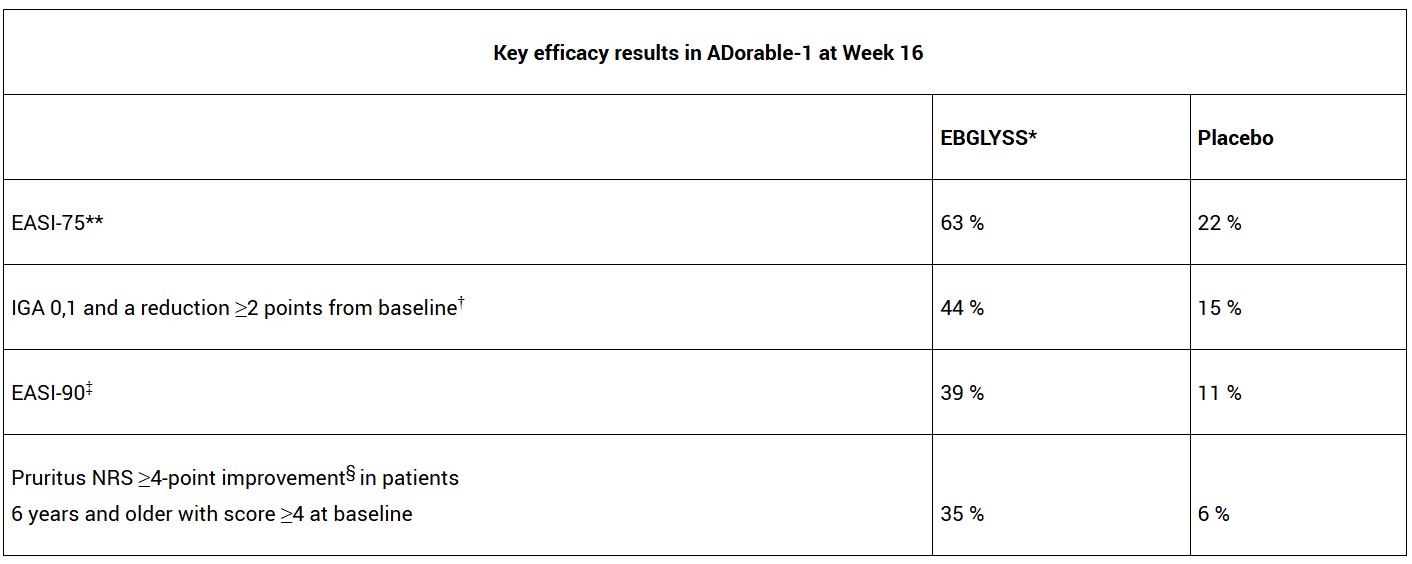
*Includes all EBGLYSS dosing regimens
**EASI=Eczema Area and Severity Index; EASI-75=75% reduction in EASI from baseline
†IGA 0,1=Investigator's Global Assessment 0 or 1 ("clear" or "almost clear")
‡EASI-90=90% reduction in EASI from baseline
§Pruritus NRS=Numeric Rating Scale rating itch from 0-10 with 10 being worst imaginable itch
within the past 24 hours
"Children with moderate-to-severe atopic dermatitis often endure relentless skin flares, itch and discomfort that can disrupt play, school and daily life for patients and caregivers," said Adrienne Brown, executive vice president and president, Lilly Immunology. "EBGLYSS has already changed what's possible for adults and adolescents, delivering durable results that help patients flare less with the option of monthly maintenance dosing. Now, these data show EBGLYSS also provided disease control in pediatric patients, a critical milestone that, if approved, could bring profound relief to these patients and their families."
The safety of EBGLYSS was consistent with the known profile in adult and adolescent patients, with no new safety signals observed. The most common adverse events occurring in ≥5% of participants were upper respiratory tract infections and nasopharyngitis, with no numerical imbalance between treatment groups. Injection site reactions were reported similarly in the EBGLYSS and placebo arms, with no injection site pain reported.
"Despite the high prevalence of moderate-to-severe atopic dermatitis in infants and young children, they have fewer approved treatment options than adults and adolescents," said Amy Paller, M.D., chair, department of dermatology at Northwestern University and ADorable study investigator. "The topline results from ADorable-1 offer hope for these young patients, delivering near-complete skin clearance and significant itch relief with a highly selective medicine that targets the underlying inflammation that drives this chronic disease."
The ADorable clinical program is ongoing. Additional results from ADorable-1 and ADorable-2, a 52-week extension study of patients enrolled in ADorable-1, will be disclosed later this year.
Lilly continues to raise the standard of care in dermatology and boldly invest in the next wave of immunology innovation, which includes big bets on next-generation modalities, the targeted expansion of small molecules and advancing novel science that uncovers the potential of incretins. Lilly recently shared topline findings from the TOGETHER-PsO and TOGETHER-PsA trials investigating the efficacy and safety of treating adults with psoriatic disease and obesity with both ixekizumab and an incretin-based therapy. Lilly's investigational therapies include DC-853, a novel oral IL-17 inhibitor being studied for psoriasis, and eltrekibart, a novel monoclonal antibody that targets neutrophil-driven inflammation and is being assessed in hidradenitis suppurativa.
Lilly has exclusive rights for development and commercialization of EBGLYSS in the U.S. and the rest of the world outside Europe. Lilly's partner Almirall has licensed the rights to develop and commercialize EBGLYSS for the treatment of dermatology indications, including atopic dermatitis, in Europe.
About ADorable-1
ADorable‑1 (NCT05559359) is a randomized, double‑blind, placebo‑controlled Phase 3 study evaluating the efficacy and safety of EBGLYSS in pediatric patients with moderate-to-severe atopic dermatitis, including infants and children as young as six months. Participants (N=363) were randomized to receive placebo or a weight-based dose of EBGLYSS. Topical corticosteroids were required beginning two weeks before randomization and throughout the 16-week study, but could be decreased or stopped once patients achieved IGA 2 or less. Data from ADorable‑1 are intended to support a potential label expansion of EBGLYSS in younger pediatric populations.
About EBGLYSS
EBGLYSS is a monoclonal antibody that selectively targets and neutralizes IL-13 with high binding affinity and a slow dissociation rate.3,4,7 EBGLYSS binds to the IL-13 cytokine at an area that overlaps with the binding site of the IL-4Rα subunit of the IL-13Rα1/IL-4Rα heterodimer, preventing formation of this receptor complex and inhibiting IL-13 signaling. IL-13 is implicated as a primary cytokine tied to the pathophysiology of eczema, driving the type-2 inflammatory loop in the skin, and EBGLYSS selectively targets IL-13.7
The EBGLYSS Phase 3 program in atopic dermatitis consists of seven key global studies evaluating over 1,600 patients, including two monotherapy studies (ADvocate 1 and 2), a combination study with topical corticosteroids (ADhere), long-term extension (ADjoin), adolescent open-label (ADore) and pediatric (ADorable 1 and 2) studies. Further data results from ADorable are expected later this year. EBGLYSS is also being studied in allergic rhinitis and chronic rhinosinusitis with nasal polyps.
EBGLYSS was approved in the U.S., Japan and Canada in 2024 and in the European Union in 2023. EBGLYSS is a first-line biologic treatment with the option of monotherapy that offers once-monthly maintenance dosing for adults and children 12 years of age and older who weigh at least 88 pounds (40 kg) with moderate-to-severe atopic dermatitis that is not well controlled with topical prescription therapies.7 EBGLYSS 250 mg/2 mL injection is dosed as a single monthly maintenance injection following the initial phase of treatment. The recommended initial starting dose of EBGLYSS is 500 mg (two 250 mg injections) at Week 0 and Week 2, followed by 250 mg every two weeks until Week 16 or later when adequate clinical response is achieved; after this, maintenance dosing is a single monthly injection (250 mg every four weeks) which can be used with or without topical corticosteroids.7
Lilly is committed to serving patients living with moderate-to-severe atopic dermatitis and is working to enable broad first-line biologic access to EBGLYSS for patients not well controlled with topical prescription therapy through commercial insurance. Lilly has coverage with all three major national pharmacy benefit managers and 94% of commercially insured patients have coverage through national health plans. We have expanded Medicaid coverage and are pursuing similarly broad Medicare coverage as part of Lilly's health equity and affordability initiative. Through Lilly Support Services, Lilly offers a patient support program including co-pay assistance for eligible, commercially insured patients.
About Lilly
Lilly is a medicine company turning science into healing to make life better for people around the world. We've been pioneering life-changing discoveries for nearly 150 years, and today our medicines help people across the globe. Harnessing the power of biotechnology, chemistry and genetic medicine, our scientists are urgently advancing new discoveries to solve some of the world's most significant health challenges: redefining diabetes care; treating obesity and curtailing its most devastating long-term effects; advancing the fight against Alzheimer's disease; providing solutions to some of the most debilitating immune system disorders; and transforming the most difficult-to-treat cancers into manageable diseases. With each step toward a healthier world, we're motivated by one thing: making life better for millions more people. That includes delivering innovative clinical trials that reflect the diversity of our world and working to ensure our medicines are accessible and affordable.
1.Shaw TE, Currie GP, Koudelka CW, Simpson EL. Eczema prevalence in the United States: data from the 2003 National Survey of Children's Health. J Invest Dermatol. 2011;131(1):67-73.
2.Simpson EL, et al. Efficacy and safety of lebrikizumab (an anti-IL-13 monoclonal antibody) in adults with moderate-to-severe atopic dermatitis inadequately controlled by topical corticosteroids: A randomized, placebo-controlled phase II trial (TREBLE). J Am Acad Dermatol. 2018;78(5):863-871.e11. doi:10.1016/j.jaad.2018.01.017
3.Okragly A, et al. Binding, Neutralization and Internalization of the Interleukin-13 Antibody, Lebrikizumab. Dermatol Ther (Heidelb). 2023;13(7):1535-1547. doi:10.1007/s13555-023-00947-7
4.Ultsch M, et al. Structural basis of signaling blockade by anti-IL-13 antibody Lebrikizumab. J Mol Biol. 2013;425(8):1330-1339. doi:10.10116/j.jmb.2013.01.024
5.Bieber T. Interleukin-13: Targeting an underestimated cytokine in atopic dermatitis. Allergy. 2020;75(1):54–62. doi:10.1111/all.13954
6.Tsoi LC, et al. Atopic Dermatitis Is an IL-13-Dominant Disease with Greater Molecular Heterogeneity Compared to Psoriasis. J Invest Dermatol. 2019;139(7):1480-1489. doi:10.1016/j.jid.2018.12.018
7.EBGLYSS. Prescribing Information. Lilly USA, LLC.