-
Improved radiographic progression-free survival (rPFS) regardless of disease volume or metastatic presentation achieved with Pluvicto plus standard of care (ARPI + ADT) in PSMAddition
-
Consistent secondary endpoint results, including PSA progression and time to mCRPC, and safety profile reinforce broad clinical applicability
-
Promising Phase 1 data for Novartis actinium-based RLT also presented, supporting two Phase 3 trials and reinforcing Novartis global RLT leadership
Basel, May 31, 2026 – Novartis today announced results showing consistent radiographic progression-free survival (rPFS) improvement across key subgroups with Pluvicto™ (lutetium Lu 177 vipivotide tetraxetan) plus standard of care (SoC; androgen receptor pathway inhibitor [ARPI] + androgen deprivation therapy [ADT]) compared to SoC alone in PSMA-positive metastatic hormone-sensitive prostate cancer (mHSPC). These PSMAddition data were presented as an oral presentation at the 2026 American Society of Clinical Oncology (ASCO) Annual Meeting.
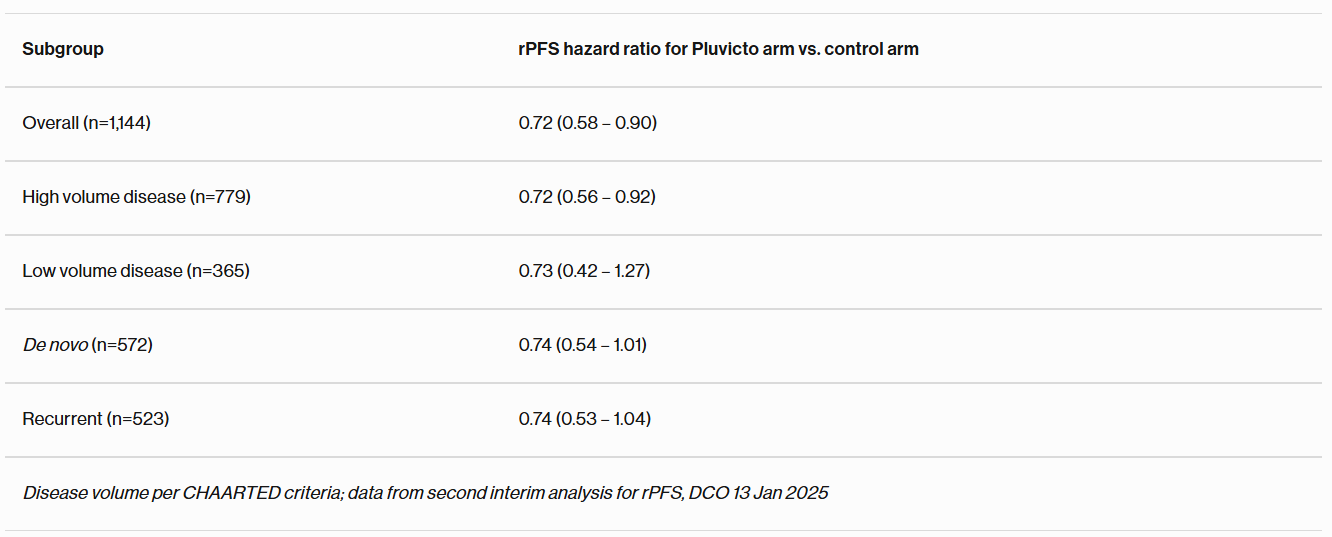
The subgroup analysis evaluated outcomes by disease volume (high or low) and disease presentation (de novo or recurrent mHSPC). Pluvicto demonstrated a similar rPFS improvement across key subgroups, consistent with the previously reported primary endpoint showing a 28% reduction in the risk of radiographic progression or death (HR 0.72; 95% CI: 0.58, 0.90). Secondary endpoints for disease progression were also consistent. Together, these data support use of Pluvicto as early as PSMA+ metastatic prostate cancer diagnosis.
“Metastatic hormone-sensitive prostate cancer is a heterogeneous disease, with disease burden and presentation often dictating how aggressively a patient’s cancer will progress,” said Fred Saad, Professor and Chairman, Department of Surgery, University of Montreal. “The consistent findings demonstrated with Pluvicto across key subgroups, regardless of initial presentation or disease volume, reinforce its potential as a cornerstone of early treatment for a broad range of patients.”
The safety profile was generally consistent across subgroups within each treatment arm, with similar incidence of adverse events (AEs). In PSMAddition, Grade ≥3 AEs were reported in 50.7% of patients in the Pluvicto plus SoC arm, compared to 43% on SoC alone. The most common all-grade AEs were dry mouth, fatigue, nausea, hot flush and anemia.
More than 186,000 men are diagnosed annually with mHSPC, now also known as metastatic androgen pathway modulation-naïve/sensitive prostate cancer (mAPMN/S), globally*1. Most patients progress to castration-resistant, or modulation-resistant (mAPMR) disease within 20 months2,3. The PSMA biomarker is present in more than 80% of patients with prostate cancer4-8.
Novartis has filed regulatory submissions in the US, China and Japan based on results from PSMAddition, with first decisions expected in H2 2026.
Promising Phase 1 data from AcTION for actinium-based RLT 225Ac-PSMA-617
Novartis also presented data for its actinium-based RLT, 225Ac-PSMA-617, from the Phase 1 AcTION trial. The data showed promising early antitumor activity with PSA declines and radiographic responses, as well as a manageable safety profile which supports further clinical development in patients with PSMA-positive metastatic castration-resistant prostate cancer (mCRPC).
“Novartis helped redefine treatment for metastatic prostate cancer with Pluvicto, and we are continuing to push the bar even higher,” said Mark Rutstein, Global Head of Oncology Development at Novartis. “Our actinium program represents the next frontier in radioligand therapy, and with two Phase 3 trials underway, we are working to extend the promise of RLTs to more patients.”
225Ac-PSMA-617 is an investigational actinium-based RLT that targets PSMA with a proven ligand to deliver short-ranged, high-energy alpha-particle radiation directly to prostate cancer cells. 225Ac-PSMA-617 is designed to induce potent tumor cytotoxicity while minimizing exposure to surrounding healthy tissues, reflecting Novartis’ strategy to advance differentiated RLTs across multiple disease stages.
Novartis is enrolling two Phase 3 trials for 225Ac-PSMA-617:
-
PSMAcTION evaluating 225Ac-PSMA-617 in mCRPC after Pluvicto, chemotherapy and ARPI
-
AcTFirst evaluating 225Ac-PSMA-617 in frontline mCRPC
Radioligand Therapy (RLT) at Novartis
Novartis is reimagining cancer care with RLT for patients with advanced cancers. By harnessing the power of targeted radiation, RLT is designed to deliver treatment directly to target cells anywhere in the body.
As a global leader in this space, Novartis has built integrated capabilities across research, manufacturing, logistics, and patient and provider support to help ensure approved RLTs reach patients reliably and efficiently. Novartis is investigating a broad portfolio of isotopes, ligands, and combination therapies to expand the use of RLT beyond prostate and neuroendocrine tumors.
About Novartis
Novartis is an innovative medicines company. Every day, we work to reimagine medicine to improve and extend people’s lives so that patients, healthcare professionals and societies are empowered in the face of serious disease. Our medicines reach more than 300 million people worldwide.
Reimagine medicine with us: Visit us at https://www.novartis.com and connect with us on LinkedIn, Facebook, X/Twitter and Instagram.
*Global incidence includes the United States, China, Japan, France, Germany, Italy, Spain and the United Kingdom
References
-
Novartis data on file.
-
Verry C, Vincendeau S, Massetti M, et al. Pattern of clinical progression until metastatic castration-resistant prostate cancer: an epidemiological study from the European Prostate Cancer Registry. Target Oncol. 2022;17(4):441-451.
-
Wenzel M, Siech C, Hoeh B, et al. Contemporary treatment patterns and oncological outcomes of metastatic hormone-sensitive prostate cancer and first- to sixth- line metastatic castration-resistant prostate cancer patients. Eur Urol Open Sci. 2024;66:46-54.
-
Hupe MC, Philippi C, Roth D, et al. Expression of prostate-specific membrane antigen (PSMA) on biopsies is an independent risk stratifier of prostate cancer patients at time of initial diagnosis. Front Oncol. 2018;8:623.
-
Bostwick DG, Pacelli A, Blute M, et al. Prostate specific membrane antigen expression in prostatic intraepithelial neoplasia and adenocarcinoma: a study of 184 cases. Cancer. 1998;82(11):2256-2261.
-
Minner S, Wittmer C, Graefen M, et al. High level PSMA expression is associated with early PSA recurrence in surgically treated prostate cancer. Prostate. 2011;71(3):281-288.
-
Hope TA, Aggarwal R, Chee B, et al. Impact of 68Ga-PSMA-11 PET on management in patients with biochemically recurrent prostate cancer. J Nucl Med. 2017;58(12):1956-1961.
-
Pomykala KL, Czernin J, Grogan TR, et al. Total-body 68Ga-PSMA-11 PET/CT for bone metastasis detection in prostate cancer patients: potential impact on bone scan guidelines. J Nucl Med. 2020;61(3):405-411.