-
In TRIUMPH-2, adults with obesity or overweight and type 2 diabetes, a population with increased difficulties losing weight, lost up to an average of 49.6 lbs (20.8%) at 80 weeks
-
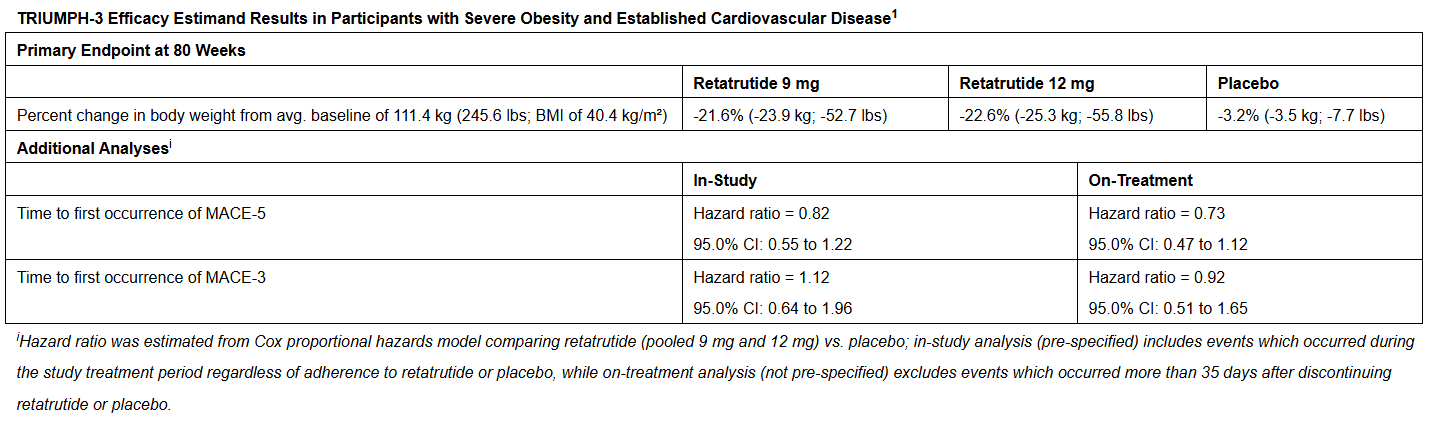
In TRIUMPH-3, adults with severe obesity and established cardiovascular disease, with or without type 2 diabetes, lost up to an average of 55.8 lbs (22.6%) at 80 weeks
-
Lilly plans to submit a Biologics License Application (BLA) for retatrutide to FDA in Q1 2027
INDIANAPOLIS, July 23, 2026 /PRNewswire/ -- Eli Lilly and Company (NYSE: LLY), the maker of Zepbound (tirzepatide) and Foundayo (orforglipron), today announced positive topline results from TRIUMPH-2 and TRIUMPH-3, two pivotal Phase 3 trials evaluating retatrutide, an investigational, first-in-class GIP, GLP-1, and glucagon triple hormone receptor agonist. In both studies, retatrutide met the primary endpoint, delivering substantial weight loss in adults with obesity and some of its most serious complications: type 2 diabetes and established cardiovascular disease.
"Across five positive Phase 3 studies, retatrutide has shown powerful efficacy, and we believe it could be an important future tool in the management of cardiometabolic health," said Kenneth Custer, Ph.D., executive vice president and president, Lilly Cardiometabolic Health. "With the positive results from TRIUMPH-2 and TRIUMPH-3, we now have the clinical data package to support global submissions for retatrutide as a potential treatment for obesity, knee osteoarthritis pain, and obstructive sleep apnea. We look forward to working with regulators as they evaluate this first-of-its-kind medicine."
In TRIUMPH-2, all three studied doses of retatrutide (4 mg, 9 mg, and 12 mg) delivered substantial weight loss and improved glycemic control at 80 weeks in adults with type 2 diabetes and obesity or overweight. Participants taking retatrutide 4 mg, 9 mg, and 12 mg lost an average of 29.8 lbs (12.7%), 45.4 lbs (19.1%), and 49.6 lbs (20.8%), respectively, alongside A1C reductions of up to an average of 1.6%.

In TRIUMPH-3, both studied doses of retatrutide (9 mg and 12 mg) delivered substantial weight loss in adults with severe obesity and established cardiovascular disease, with or without type 2 diabetes. Participants lost up to an average of 55.8 lbs (22.6%) at 80 weeks.
In the study, major adverse cardiovascular events (MACE) occurred less frequently than anticipated in both retatrutide and placebo arms. In pre-specified analyses for time to first occurrence of MACE, there were 44 MACE-5 (all-cause death, heart attack, stroke, heart failure event, or coronary revascularization) events observed in participants randomized to retatrutide (pooled 9 mg and 12 mg) and 52 events observed in those randomized to placebo, resulting in a hazard ratio of 0.82 (95.0% CI: 0.55 to 1.22). There were 27 MACE-3 (cardiovascular death, heart attack, or stroke) events in participants randomized to retatrutide and 23 in those randomized to placebo, resulting in a hazard ratio of 1.12 (95.0% CI: 0.64 to 1.96).
In TRIUMPH-3, retatrutide meaningfully reduced certain cardiovascular risk factors, with the highest dose delivering average reductions of 37.0% in triglycerides, 16.5% in non-HDL cholesterol, 9.3 mmHg in systolic blood pressure, 7.5 in (19.0 cm) in waist circumference, and 51.2% in high-sensitivity C-reactive protein (hsCRP).
In TRIUMPH-2, the most common adverse events with retatrutide (4 mg, 9 mg, 12 mg vs. placebo, respectively) were diarrhea (27.4%, 33.5%, 33.6% vs. 13.2%), nausea (13.7%, 20.8%, 28.0% vs. 8.0%), constipation (14.0%, 16.2%, 16.8% vs. 9.4%), decreased appetite (5.8%, 12.3%, 17.1% vs. 4.5%), and vomiting (5.5%, 10.2%, 15.7% vs. 4.2%). In TRIUMPH-3, the most common adverse events with retatrutide (9 mg, 12 mg vs. placebo, respectively) were diarrhea (30.1%, 24.4% vs. 8.7%), nausea (21.7%, 22.4% vs. 5.8%), constipation (18.0%, 15.7% vs. 7.1%), decreased appetite (13.5%, 14.5% vs. 3.0%), and hyperglycemia (3.9%, 3.1% vs. 13.4%). In TRIUMPH-2, the incidence of dysesthesia and urinary tract infections were 4.5%, 5.6%, 7.3% vs. 0.7% and 3.8%, 6.3%, 8.0% vs. 6.6% with retatrutide 4 mg, 9 mg, 12 mg vs. placebo, respectively. In TRIUMPH-3, the incidence of dysesthesia and urinary tract infections were 6.4%, 6.4% vs. 1.3% and 6.1%, 7.0% vs. 5.3% with retatrutide 9 mg, 12 mg vs. placebo, respectively. These events were generally mild to moderate, and the majority resolved during treatment. Discontinuation rates due to adverse events in TRIUMPH-2 were 3.8% (4 mg), 11.6% (9 mg), and 7.7% (12 mg) with retatrutide, compared with 4.9% for placebo. Discontinuation rates due to adverse events in TRIUMPH-3 were 9.8% (9 mg) and 13.5% (12 mg) with retatrutide, compared with 4.8% for placebo.
Detailed results from TRIUMPH-2 and TRIUMPH-3 will be presented at future medical meetings and published in peer-reviewed journals. Lilly is completing the comprehensive Chemistry, Manufacturing, and Controls (CMC) data package required for a Biologics License Application (BLA) and plans to subsequently submit retatrutide in Q1 2027 for U.S. approval.
About retatrutide
Retatrutide is an investigational, once-weekly, triple hormone receptor agonist. Retatrutide is a single molecule that activates the body's receptors for glucose-dependent insulinotropic polypeptide (GIP), glucagon-like peptide-1 (GLP-1), and glucagon. Lilly is studying retatrutide in several Phase 3 clinical trials to evaluate its potential efficacy and safety in obesity and overweight with at least one weight-related medical problem, type 2 diabetes, knee osteoarthritis pain, moderate-to-severe obstructive sleep apnea, chronic low back pain, cardiovascular and renal outcomes, and metabolic dysfunction-associated steatotic liver disease. Retatrutide is an investigational molecule that cannot be legally sold or marketed for human use.
About TRIUMPH-2, TRIUMPH-3, and the TRIUMPH clinical trial program
TRIUMPH-2 (NCT05929079) is a Phase 3, 80-week, randomized, double-blind, and placebo-controlled trial under a basket design investigating the efficacy and safety of retatrutide once weekly compared with placebo in participants with type 2 diabetes and obesity or overweight. The study randomized 1,152 participants in a 1:1:1:1 ratio to receive retatrutide 4 mg, 9 mg, 12 mg, or placebo. Participants randomized to retatrutide initiated treatment with 2 mg once weekly and increased the dose in a stepwise approach every four weeks until reaching the target dose of 4 mg (via steps at 2 mg and 4 mg), 9 mg (via steps at 2 mg, 4 mg, and 6 mg) or 12 mg (via steps at 2 mg, 4 mg, 6 mg, and 9 mg). TRIUMPH-2 included a post-treatment follow-up period of four weeks.
TRIUMPH-3 (NCT05882045) is a Phase 3, 80-week, randomized, double-blind, placebo-controlled trial investigating the efficacy and safety of retatrutide once weekly compared with placebo in participants with severe obesity (Class 2 or Class 3), defined as BMI ≥35 kg/m2, and established cardiovascular disease. The study randomized 1,949 participants in a 1:1:2 ratio to receive retatrutide 9 mg, 12 mg, or placebo. Participants randomized to retatrutide initiated treatment with 2 mg once weekly and increased the dose in a stepwise approach every four weeks until reaching the target dose of 9 mg (via steps at 2 mg, 4 mg, and 6 mg) or 12 mg (via steps at 2 mg, 4 mg, 6 mg, and 9 mg).
The initial TRIUMPH Phase 3 clinical development program is evaluating the safety and efficacy of retatrutide for the treatment of patients with obesity or overweight, moderate-to-severe obstructive sleep apnea and obesity, and knee osteoarthritis pain across four global registrational trials. The program, which began in 2023, enrolled more than 5,800 participants.
Endnotes:
-
The efficacy estimand represents efficacy had all randomized participants remained on study intervention (with possible dose interruptions and modifications) without initiating prohibited weight management treatments (and glycemic rescue therapy for glycemic endpoints only).
ZP CON BS 25FEB2026
Zepbound®, its delivery device base and KwikPen® are registered trademarks owned or licensed by Eli Lilly and Company, its subsidiaries, or affiliates.
About Lilly
Lilly is a medicine company turning science into healing to make life better for people around the world. We've been pioneering life-changing discoveries for 150 years, and today our medicines help tens of millions of people across the globe. Harnessing the power of biotechnology, chemistry and genetic medicine, our scientists are urgently advancing new discoveries to solve some of the world's most significant health challenges: redefining diabetes care; treating obesity and curtailing its most devastating long-term effects; advancing the fight against Alzheimer's disease; providing solutions to some of the most debilitating immune system disorders; and transforming the most difficult-to-treat cancers into manageable diseases. With each step toward a healthier world, we're motivated by one thing: making life better for millions more people. That includes delivering innovative clinical trials that reflect the diversity of our world and working to ensure our medicines are accessible and affordable.