-
RINVOQ is now approved in the European Union for the treatment of active polyarticular juvenile idiopathic arthritis (pJIA) in patients two years of age and older who have responded inadequately to, or who are intolerant to, one or more DMARDs1
-
Approval was based on the open-label Phase 1 SELECT-YOUTH study and data from adults with rheumatoid arthritis1,2
-
A new oral solution of RINVOQ was approved for use in patients with pJIA1
-
RINVOQ is currently approved in the European Union for 11 indications across various immune-mediated, inflammatory diseases1
NORTH CHICAGO, Ill., Sept. 22, 2026 /PRNewswire/ -- AbbVie (NYSE: ABBV) today announced that the European Commission (EC) has approved RINVOQ® (upadacitinib; 15 mg tablet and weight-based 1 mg/mL oral solution) for the treatment of active polyarticular juvenile idiopathic arthritis (polyarticular rheumatoid factor positive [RF+] or negative [RF-], extended oligoarticular), in patients two years of age and older who have responded inadequately to, or who are intolerant to, one or more disease-modifying anti-rheumatic drugs (DMARDs). RINVOQ may be used as monotherapy or in combination with methotrexate.1
"The European Commission's approval of RINVOQ for pJIA expands the treatment options available to pediatric patients and their families, offering the potential for remission, improvements in pain and physical function," said Roopal Thakkar, M.D., executive vice president, research and development, chief scientific officer, AbbVie. "RINVOQ's new indication continues to build on our differentiated immunology portfolio with breadth and depth across therapeutic areas and patient populations."
Juvenile idiopathic arthritis (JIA) is the most common rheumatic disease of childhood and is estimated to impact approximately 126,000 children in Europe.3 pJIA is a subtype of JIA and is characterized by inflammation in five or more joints – including the small joints of the hands and feet and large joints like the knees, hips and ankles – that persists for at least six weeks in children and adolescents.4,5 This disease can be painful and debilitating and, if left untreated, may lead to joint damage.3,6 Ongoing disease activity in pJIA is common, with persistent symptoms or flares affecting many patients into adulthood.6-8
Data Supporting the EC Approval
The EC approval of RINVOQ for pJIA is supported by the SELECT-YOUTH study and data from adult patients with rheumatoid arthritis. The SELECT-YOUTH study is a single-arm, open-label, global, Phase 1 study evaluating the pharmacokinetics, efficacy, safety and tolerability of RINVOQ in patients ages 2 to <18 years.1,2
RINVOQ demonstrated efficacy as early as week 12, with response rates improving through week 48, as shown below.1,2 The efficacy observed in children with pJIA was generally consistent with responses in adult patients with rheumatoid arthritis.1
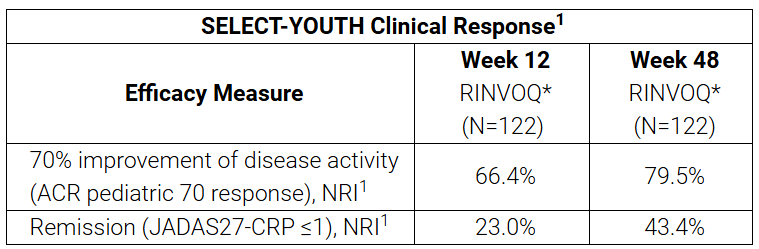
*All patients received RINVOQ 15 mg tablet or oral solution weight-based equivalent.
ACR=American College of Rheumatology; CRP=C-reactive protein; JADAS=Juvenile Arthritis Disease Activity Score; NRI=nonresponder imputation.
Functional ability, as measured by C-HAQ, improved, with a mean change from baseline of −0.46 (n=115) at week 12 and −0.64 (n=108) at week 48. Pain scores also improved, with a mean change from baseline of −26.2 (n=116) at week 12 and −30.8 (n=109) at week 48. C-HAQ and pain data are reported as observed.2
In the study, no new safety risks were identified.9 The rate of treatment-emergent adverse events (TEAEs) was 499.6 events per 100 patient-years (E/100 PY). The rate of serious adverse events was 10.2 E/100 PY. The rate of TEAEs that led to discontinuation of the study drug was 2.7 E/100 PY. No cases of major cardiovascular or thrombotic events, malignancies or deaths were reported during the study period.2 No negative impact on growth or development was observed.9
"The SELECT-YOUTH results underscore that clinical remission for children with pJIA is not a rare hope but a critical and achievable outcome that helps reduce the risk of permanent joint damage in some of our youngest, most vulnerable patients," said Prof. Dr. Gerd Horneff, head of the Department of General Pediatrics, Asklepios Clinic, Sankt Augustin, Germany. "The approval of RINVOQ in active pJIA provides a new oral systemic treatment option for patients suffering from this often-debilitating condition."
RINVOQ is also approved in the European Union for the treatment of adults and adolescents with atopic dermatitis, non-segmental vitiligo and alopecia areata and for adults with radiographic axial spondyloarthritis, non-radiographic axial spondyloarthritis, psoriatic arthritis, rheumatoid arthritis, ulcerative colitis, Crohn's disease and giant cell arteritis.1
About the SELECT-YOUTH Study
The SELECT-YOUTH (M15-340) study is a single-arm, open-label, global, Phase 1 study to evaluate the pharmacokinetics, efficacy, safety and tolerability of upadacitinib in patients with polyarticular course juvenile idiopathic arthritis (pcJIA), ages 2 to <18 years. This study consists of three parts: Part 1 consisted of a seven-day multiple-dose pharmacokinetic evaluation, after which patients in Parts 2 and 3 of the trial received a low dose of upadacitinib (equivalent to 15 mg) by using either a twice-daily oral solution or once-daily extended-release tablet based on their body weight and ability to swallow tablets. For more detailed information on this study, please visit clinicaltrials.gov (NCT03725007).
About RINVOQ® (upadacitinib)
Discovered and developed by AbbVie scientists, RINVOQ is a selective and reversible JAK inhibitor that is being studied in several immune-mediated inflammatory diseases.1,10 In human cellular assays, RINVOQ preferentially inhibits signaling by JAK1 or JAK 1/3 with functional selectivity over cytokine receptors that signal via pairs of JAK2.1
Upadacitinib (RINVOQ) is being studied in Phase 3 clinical trials for hidradenitis suppurativa, Takayasu arteritis and systemic lupus erythematosus and in pediatric studies for systemic juvenile idiopathic arthritis, atopic dermatitis, ulcerative colitis and Crohn's disease.
About AbbVie in Immunology
AbbVie is relentless in our pursuit to redefine the standard of care for patients living with immune-mediated conditions, with the goal of helping them live a life free from the limitations of their disease. For more than 20 years, AbbVie has led and helped shape the field of immunology through groundbreaking science and trusted medicines. Building on deep expertise across gastroenterology, rheumatology and dermatology, and other areas of high unmet need, we continue to invest in a broad and differentiated pipeline – spanning innovative modalities, novel mechanisms of actions and next-generation approaches designed to conquer the complex biology underlying immune-mediated disease.
Today, more than 1 million patients worldwide are treated with AbbVie's immunology medicines, approved in more than 175 countries across 20+ immune-mediated diseases that impact adult and pediatric populations. As we work to strengthen our legacy and drive the next wave of innovation, we remain focused on delivering meaningful progress for patients and expanding access to our medicines.
About AbbVie
AbbVie's mission is to discover and deliver innovative medicines and solutions that solve serious health issues today and address the medical challenges of tomorrow. We strive to have a remarkable impact on people's lives across several key therapeutic areas including immunology, neuroscience and oncology – and products and services in our Allergan Aesthetics portfolio.
References
-
RINVOQ. Summary of product characteristics. AbbVie; 2026.
-
AbbVie. Data on file: ABVRRTI83601.
-
Garner AJ, Saatchi R, Ward O, Hawley DP. Juvenile idiopathic arthritis: a review of novel diagnostic and monitoring technologies. Healthcare (Basel). 2021;9(12):1683. doi:10.3390/healthcare9121683
-
Macaubas C, Nguyen K, Milojevic D, Park JL, Mellins ED. Oligoarticular and polyarticular JIA: epidemiology and pathogenesis. Nat Rev Rheumatol. 2009;5(11):616-626. doi:10.1038/nrrheum.2009.209
-
Petty RE, Southwood TR, Manners P, et al. International League of Associations for Rheumatology classification of juvenile idiopathic arthritis: second revision, Edmonton, 2001. J Rheumatol. 2004;31(2):390-392.
-
Hashkes PJ, Laxer RM. Medical treatment of juvenile idiopathic arthritis. JAMA. 2005;294(13):1671-1684. doi:10.1001/jama.294.13.1671
-
Glerup M, Rypdal V, Arnstad ED, et al. Long-term outcomes in juvenile idiopathic arthritis: eighteen years of follow-up in the population-based Nordic juvenile idiopathic arthritis cohort. Arthritis Care Res (Hoboken). 2020;72(4):507-516. doi:10.1002/acr.23853
-
Balay-Dustrude E, Weiss NS, Sutton A, Shenoi S. Predictors of disease activity in patients with juvenile idiopathic arthritis at 12 and 24 months after diagnosis. ACR Open Rheumatol. 2024;6(8):489-496. doi:10.1002/acr2.11701
-
AbbVie. Data on file: ABVRRTI83825.
-
Pipeline. AbbVie. 2026. Accessed July 8, 2026. https://www.abbvie.com/our-science/pipeline.html