-
INTerpath-001 data to be presented in Presidential Symposium, featuring the first Phase 3 results for investigational intismeran autogene plus KEYTRUDA® (pembrolizumab), demonstrating improvements in recurrence-free survival and distant metastasis-free survival versus KEYTRUDA alone in patients with completely resected stage IIB-IV melanoma in the adjuvant setting
-
Investigational sacituzumab tirumotecan (sac-TMT) data from TroFuse-005, the first and only Phase 3 trial of a TROP2-directed antibody-drug conjugate to improve overall survival and progression-free survival in certain patients with advanced or recurrent endometrial cancer, will be presented in a Presidential Symposium
-
KEYNOTE-C93 data to be presented in Presidential Symposium suggesting important role of first-line KEYTRUDA monotherapy for certain patients with mismatch repair deficient (dMMR) advanced or recurrent endometrial cancer
October 13, 2026--RAHWAY, N.J.--(BUSINESS WIRE)-- Merck (NYSE: MRK), known as MSD outside of the United States and Canada, today announced that first-time results from three pivotal clinical trials will be presented during late-breaking Presidential Symposia at the European Society for Medical Oncology (ESMO) Congress 2026 in Madrid, Spain from Oct. 23-27. Additionally, more than 90 additional abstracts across more than 20 tumor types from the company’s pipeline and portfolio will be presented throughout the meeting.
“New data at ESMO, including three Presidential Symposia from three pivotal trials, reflect the strength and depth of Merck’s industry-leading oncology portfolio and pipeline,” said Dr. Marjorie Green, senior vice president and head of oncology global clinical development, Merck Research Laboratories. "We are proud to share Phase 3 data for the first time from intismeran and sac-TMT, alongside new research from our oncology portfolio, reflecting our commitment to advancing research across a range of cancer types."
Key data from Merck’s pipeline and portfolio to be presented:
-
First presentation of data from the pivotal Phase 3 INTerpath-001 trial evaluating intismeran autogene (intismeran; V940/mRNA-4157), a novel investigational mRNA-based individualized neoantigen therapy, in combination with KEYTRUDA ®(pembrolizumab), Merck’s anti-PD-1 therapy, as adjuvant treatment for patients with completely resected stage IIB-IV melanoma, which will be featured in an ESMO Presidential Symposium (Presentation #LBA1, Proffered paper session: Presidential Symposium I). 1
-
First presentation of data from the pivotal Phase 3 TroFuse-005 trial evaluating sacituzumab tirumotecan (sac-TMT), an investigational trophoblast cell-surface antigen 2 (TROP2)-directed antibody-drug conjugate, for patients with advanced or recurrent endometrial cancer who have progressed after platinum-based chemotherapy and a programmed death receptor-1 (PD-1) or programmed death-ligand 1 (PD-L1) inhibitor, which will be featured in an ESMO Presidential Symposium (Presentation #LBA11, Proffered paper session: Presidential Symposium III). 2,3
-
First presentation of data from the Phase 3 KEYNOTE-C93 trial evaluating KEYTRUDA monotherapy as a first-line treatment for patients with mismatch repair deficient (dMMR) advanced or recurrent endometrial cancer who had not previously received systemic chemotherapy or who experienced recurrence after receiving prior adjuvant therapy, which will be featured in an ESMO Presidential Symposium (Presentation #LBA12, Proffered paper session: Presidential Symposium III). 3
-
Data from Phase 3 OptiTROP studies evaluating sac-TMT in non-small cell lung cancer (NSCLC), including results from the OptiTROP-Lung06 study (Presentation #LBA66) in first-line PD-L1-negative advanced non-squamous NSCLC and final overall survival data from the OptiTROP-Lung04 study (Presentation #LBA67) in epidermal growth factor receptor (EGFR)-mutated NSCLC following progression on EGFR tyrosine kinase inhibitors (TKIs) (Proffered paper session 1: NSCLC, metastatic). 4
-
Final analysis results from the Phase 3 LITESPARK-011 study evaluating WELIREG ®(belzutifan), Merck’s first-in-class, oral hypoxia-inducible factor-2 alpha (HIF-2α) inhibitor, in combination with LENVIMA ®(lenvatinib), an orally available multiple receptor TKI discovered by Eisai, for patients with advanced renal cell carcinoma with a clear cell component following a PD-1 or PD-L1 inhibitor (Presentation #3587O, Proffered paper session 2: Genitourinary tumours, renal and urothelial). 5
Merck investor event
Merck will hold an Oncology Investor Event to coincide with the ESMO 2026 Congress on Monday, October 26, 7:30 p.m. CET/2:30 p.m. ET, during which senior management will provide an update on the company’s oncology strategy and program. The event will take place in Madrid, Spain, and will be accessible via webcast. Investors, analysts, members of the media and the general public are invited to listen to a webcast of the presentation via this weblink. All participants may join the call by dialing (800) 369-2154 (U.S. and Canada Toll-Free) or (517) 308-9422 and using the access code 8984239.
Details on presentations listed above and additional key presentations for Merck


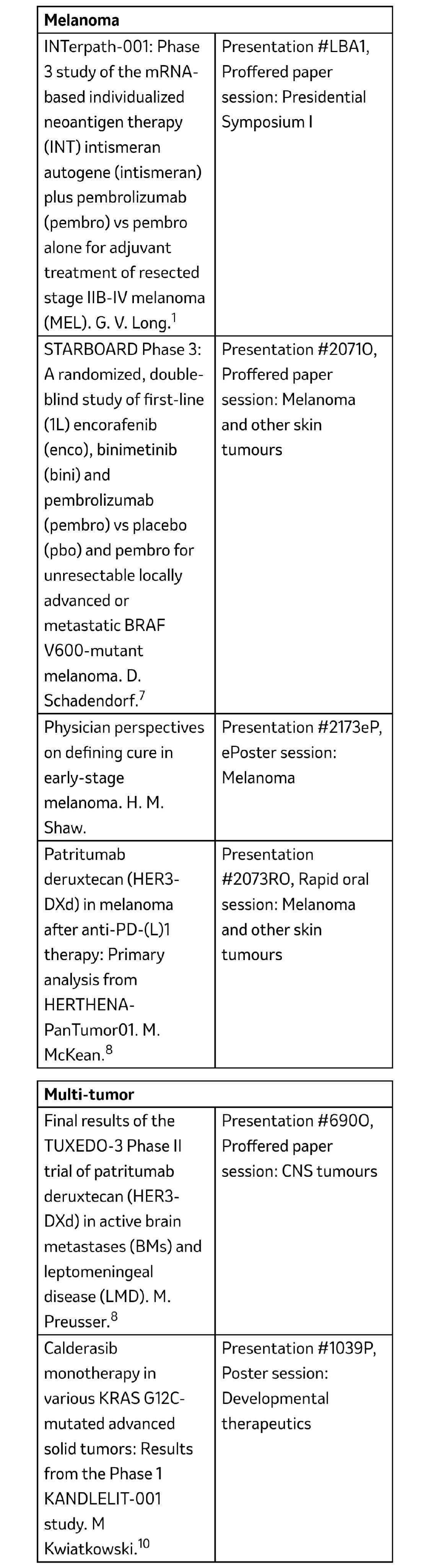
1 In collaboration with Moderna
2 In collaboration with Kelun-Biotech
3 In collaboration with the European Network for Gynaecological Oncology Trial (ENGOT) groups and the GOG Foundation, Inc. (GOG)
4 Led by Kelun-Biotech, conducted in China
5 In collaboration with Eisai
6 In collaboration with Gilead
7 In collaboration with Astellas/Pfizer
8 In collaboration with Daiichi Sankyo
9 Sponsored by U.S. National Cancer Institute (NCI)/led by NRG Oncology
10 In collaboration with Taiho Pharmaceutical Co. Ltd and Astex Pharmaceuticals (UK), a wholly owned subsidiary of Otsuka Pharmaceutical Co., Ltd
About intismeran autogene
Intismeran autogene (intismeran; V940 or mRNA-4157) is a novel, potential first-in-class investigational messenger RNA (mRNA)-based individualized neoantigen therapy (INT) jointly developed by Merck and Moderna. Intismeran is designed and produced using a patient's tumor sample to identify the unique mutational signature, or "fingerprint," of their cancer and generate an anti-tumor immune response. Each therapy consists of a synthetic mRNA coding for up to 34 neoantigens and is tailored to the unique biology of an individual patient's tumor. Upon administration, the RNA-encoded neoantigen sequences are translated in the body and presented to the immune system, a key step in generating specific T-cell responses against cancer cells. Individualized neoantigen therapies are designed to train and activate an anti-tumor immune response based on the unique mutational signature of a patient's tumor. Merck and Moderna are advancing the robust INTerpath clinical development program evaluating the safety and efficacy of intismeran in combination with KEYTRUDA and other anti-cancer therapies, and as a monotherapy.
About sacituzumab tirumotecan (sac-TMT)
Sac-TMT is an investigational TROP2-directed ADC with a belotecan-derived topoisomerase I inhibitor payload and a unique bifunctional linker designed with the potential to maximize payload delivery to tumor cells and minimize payload loss while circulating in the body.
TROP2 is overexpressed on tumor cells compared to healthy cells in many common cancers, and through the TroFuse clinical development program, Merck is evaluating sac-TMT in 18 ongoing global Phase 3 trials across multiple tumor types, the broadest range of disease and treatment settings compared to any TROP2-directed ADC to date. The TroFuse development program spans early-to-late-stage disease in more than nine disease areas and includes more than 15,000 patients worldwide. Numerous Phase 3 trials are exploring sac-TMT as monotherapy and in combination with immunotherapies, aiming to improve survival and quality of life for patients with advanced and earlier-stage cancers.
About calderasib
Calderasib (MK-1084) is an investigational, highly potent and specific next-generation KRAS G12C covalent inhibitor. Mutations in KRAS are among the most prevalent mutations found in cancer, occurring with high frequency in non-small cell lung cancer (NSCLC), pancreatic, urogenital and colorectal cancers. The KRAS G12C mutation is the most frequently observed KRAS mutation in patients, occurring in approximately 14% of patients with NSCLC (adenocarcinoma). Despite decades of research and recognition of the therapeutic importance of targeting KRAS, the development of small molecule inhibitors targeting KRAS mutations has been challenging.
About KEYTRUDA® (pembrolizumab) injection for intravenous use, 100 mg
KEYTRUDA is an anti-programmed death receptor-1 (PD-1) therapy that works by increasing the ability of the body’s immune system to help detect and fight tumor cells. KEYTRUDA is a humanized monoclonal antibody that blocks the interaction between PD-1 and its ligands, PD-L1 and PD-L2, thereby activating T lymphocytes which may affect both tumor cells and healthy cells.
Merck has the industry’s largest immuno-oncology clinical research program. There are currently more than 2,800 trials studying KEYTRUDA across a wide variety of cancers and treatment settings. The KEYTRUDA clinical program seeks to understand the role of KEYTRUDA across cancers and the factors that may predict a patient's likelihood of benefitting from treatment with KEYTRUDA, including exploring several different biomarkers.
About WELIREG® (belzutifan) 40 mg tablets, for oral use
WELIREG, Merck’s first-in-class hypoxia-inducible factor 2 alpha (HIF-2α) inhibitor, is an orally administered small-molecule that in conditions of hypoxia or impairment of VHL protein function, blocks HIF-2alpha and HIF-1beta interaction, which may reduce the transcription and expression of HIF-2α target genes associated with cellular proliferation, angiogenesis and tumor growth. By inhibiting HIF-2α signaling, WELIREG may disrupt key pathways certain tumors may use to adapt to low-oxygen conditions, including those that help promote abnormal blood vessel formation and support tumor survival.
WELIREG has received regulatory approvals in certain patients with advanced renal cell carcinoma with a clear cell component (ccRCC) and adjuvant ccRCC in combination with KEYTRUDA or KEYTRUDA QLEX, von Hippel-Lindau (VHL) disease-associated tumors and pheochromocytoma or paraganglioma (PPGL). As part of a broader clinical program, Merck continues to research WELIREG for people with RCC and selected solid tumors across different treatment settings, to further understand where WELIREG may provide clinical benefit.
About LENVIMA® (lenvatinib); available as 10 mg and 4 mg capsules
LENVIMA, discovered and developed by Eisai, is an orally available multiple receptor tyrosine kinase inhibitor that inhibits the kinase activities of vascular endothelial growth factor (VEGF) receptors VEGFR1 (FLT1), VEGFR2 (KDR), and VEGFR3 (FLT4). LENVIMA inhibits other kinases that have been implicated in pathogenic angiogenesis, tumor growth, and cancer progression in addition to their normal cellular functions, including fibroblast growth factor (FGF) receptors FGFR1-4, the platelet derived growth factor receptor alpha (PDGFRα), KIT, and RET. In syngeneic mouse tumor models, LENVIMA decreased tumor-associated macrophages, increased activated cytotoxic T cells, and demonstrated greater antitumor activity in combination with an anti-PD-1 monoclonal antibody compared to either treatment alone. The combination of LENVIMA and everolimus showed increased antiangiogenic and antitumor activity as demonstrated by decreased human endothelial cell proliferation, tube formation, and VEGF signaling in vitro and tumor volume in mouse xenograft models of human renal cell cancer greater than each drug alone.
About the Merck and Kelun-Biotech strategic collaboration
Sac-TMT was developed by Kelun-Biotech. Kelun-Biotech (6990.HK) is a holding subsidiary of Kelun Pharmaceutical (002422.SZ), which focuses on the R&D, manufacturing, commercialization and global collaboration of innovative biological drugs and small molecule drugs. Under a collaboration agreement, Kelun-Biotech has granted Merck the exclusive rights to develop, manufacture and commercialize sac-TMT in all territories outside of Greater China (which includes Mainland China, Hong Kong, Macau and Taiwan).
About the Merck and Eisai strategic collaboration
In March 2018, Eisai and Merck, known as MSD outside of the United States and Canada, through an affiliate, entered into a strategic collaboration for the worldwide co-development and co-commercialization of LENVIMA. Under the agreement, the companies jointly develop, manufacture and commercialize LENVIMA, both as monotherapy and in combination with Merck’s anti-PD-1 therapy, KEYTRUDA, and Merck’s HIF-2α inhibitor, WELIREG.
About the Merck, Pfizer and Astellas collaboration
Merck previously entered a clinical collaboration agreement with Seagen and Astellas to evaluate the combination of Merck’s KEYTRUDA® (pembrolizumab) and Seagen’s and Astellas’ Padcev® (enfortumab vedotin-ejfv) in patients with urothelial cancer. Padcev® and the Padcev device are trademarks jointly owned by Agensys, Inc., and Seagen Inc. Pfizer Inc. completed its acquisition of Seagen on December 14, 2023.
About the Daiichi Sankyo and Merck collaboration
Daiichi Sankyo and Merck entered into a global collaboration in October 2023 to jointly develop and commercialize ifinatamab deruxtecan (I-DXd), raludotatug deruxtecan (R-DXd) and patritumab deruxtecan (HER3-DXd), except in Japan where Daiichi Sankyo will maintain exclusive rights. Daiichi Sankyo will be solely responsible for manufacturing and supply. In August 2024, the global co-development and co-commercialization agreement was expanded to include gocatamig (MK-6070/DS3280), which the companies will jointly develop and commercialize worldwide, except in Japan where Merck will maintain exclusive rights. Merck will be solely responsible for manufacturing and supply for gocatamig.
Merck’s focus on cancer
Every day, we follow the science as we work to discover innovations that can help patients, no matter what stage of cancer they have. As a leading oncology company, we are pursuing research where scientific opportunity and medical need converge, underpinned by our diverse pipeline of more than 20 novel mechanisms. With one of the largest clinical development programs across more than 25 tumor types, we strive to advance breakthrough science that will shape the future of oncology. By addressing barriers to clinical trial participation, screening and treatment, we work with urgency to reduce disparities and help ensure patients have access to high-quality cancer care. Our unwavering commitment is what will bring us closer to our goal of bringing life to more patients with cancer.
About Merck
At Merck, known as MSD outside of the United States and Canada, we are unified around our purpose: We use the power of leading-edge science to save and improve lives around the world. For more than 130 years, we have brought hope to humanity through the development of important medicines and vaccines. We aspire to be the premier research-intensive biopharmaceutical company in the world – and today, we are at the forefront of research to deliver innovative health solutions that advance the prevention and treatment of diseases in people and animals. We foster a diverse and inclusive global workforce and operate responsibly every day to enable a safe, sustainable and healthy future for all people and communities.