-
Higher rates of endoscopic remission and ulcer-free endoscopy were observed following subcutaneous SKYRIZI® (risankizumab-rzaa)treatment versus placeboi
-
Results build on previously reported week 12 findings in which SKYRIZI achieved superiority in the co-primary endpoints of clinical remission and endoscopic response versus placebo
-
These data support the application to the U.S. Food and Drug Administration seeking approval of a subcutaneous induction dosing regimen for SKYRIZI for patients with moderately to severely active Crohn's disease
NORTH CHICAGO, Ill., Oct. 13, 2026 /PRNewswire/ -- AbbVie today announced new findings from the Phase 3 AFFIRM study evaluating a new option for induction treatment with SKYRIZI® (risankizumab-rzaa) in adults with moderately to severely active Crohn's disease (CD). Presented at the American College of Gastroenterology 2026 Annual Scientific Meeting, the findings build on the previously reported efficacy results of subcutaneous (SC) SKYRIZI® treatment, showing new endoscopic remissionii and ulcer-free endoscopyiii outcomes for patients receiving SKYRIZI subcutaneously.i
After treatment with SKYRIZI, 35.8% of patients achieved endoscopic remission, or the healing of the intestinal lining with little to no visible inflammation.i Across subgroups, 36.6% of patients who had ulcers at the start of the study achieved the complete absence of ulcers, known as ulcer-free endoscopy, after induction and maintenance treatment.i Among advanced therapy-naïve patients, rates were higher, with 45.1% achieving endoscopic remission and 49.0% achieving ulcer-free endoscopy, representing the highest rates observed across the evaluated subgroups.i
Evaluating subcutaneous SKYRIZI against stringent endoscopic outcomes demonstrates its potential to help CD patients achieve deeper control of underlying inflammation with a fully patient-administered regimen. Subcutaneous induction with SKYRIZI for adults with moderately to severely active CD is currently under regulatory review with the U.S. Food and Drug Administration and European Medicines Agency.
"Controlling underlying inflammation can limit the amount of time people living with Crohn's disease spend experiencing debilitating flares," said Kori Wallace, M.D., Ph.D., vice president, global head of immunology clinical development, AbbVie. "The findings reported in AFFIRM are important because not only were the endoscopic outcomes higher with SKYRIZI, but they were achieved after induction, demonstrating the potential of subcutaneous SKYRIZI for helping patients achieve disease control early in their treatment journey."
AFFIRM included patients with longstanding, difficult-to-treat CD; 65% had previously experienced an inadequate response to advanced therapies. Patients had lived with the disease for an average of more than seven years and had substantial intestinal inflammation at study entry.i
"In clinical practice, we're making treatment decisions for patients at very different points in their disease, from those starting their first advanced therapy to those who have already cycled through several," said Millie D. Long, M.D., MPH, chief, division of gastroenterology and hepatology, University of North Carolina at Chapel Hill, and lead investigator of AFFIRM. "Seeing the endoscopic improvements in both advanced therapy-naïve and treatment-experienced patients observed in AFFIRM gives clinicians meaningful evidence to inform decisions across the treatment journey."
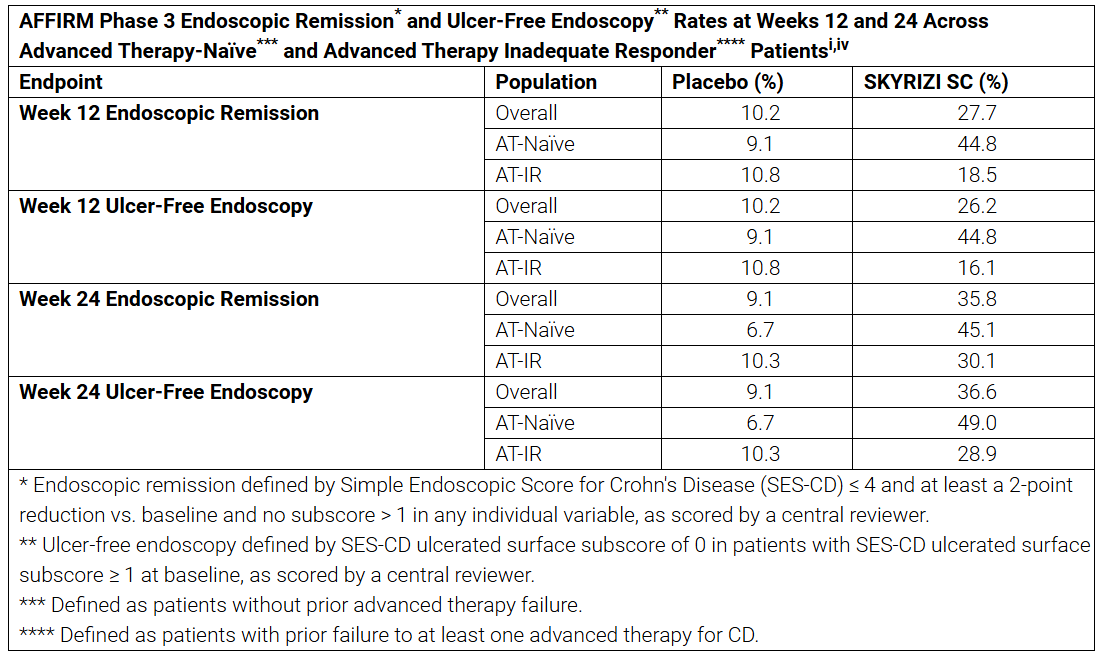
Safety findings through week 24 were consistent with the known safety profile of risankizumab, with lower rates of treatment-emergent adverse events observed in the risankizumab treatment groups versus placebo during both induction and maintenance.i Rates of adverse events of special interest remained low, and no new safety signals were identified.i
About Crohn's Disease
Crohn's disease is a chronic, systemic disease that manifests as inflammation within the gastrointestinal tract, most commonly in the area between the small intestine (ileum) and the colon, causing persistent diarrhea and abdominal pain.v,vi It is a progressive disease, meaning it gets worse over time and may lead to life-threatening complications or surgery.vii,viii Because the signs and symptoms of Crohn's disease are unpredictable, it causes a significant burden on people living with the disease—not only physically but also emotionally and economically.ix
About the AFFIRM Studyi
AFFIRM is a global, Phase 3, randomized, placebo-controlled, double-blind study to evaluate the efficacy and safety of risankizumab subcutaneous (SC) as an induction treatment in adult patients with moderately to severely active Crohn's disease. Co-primary endpoints were percentage of participants with CDAI Clinical Remission (CDAI < 150) and percentage of participants with endoscopic response at week 12. A total of 289 patients were randomized in a 2:1 ratio to risankizumab SC or placebo. Key demographics and baseline characteristics were generally balanced between the risankizumab SC and placebo groups; 65% had failed advanced therapies for the treatment of CD before. The study consists of three treatment periods: a placebo-controlled Period A (baseline to week 12) to evaluate the efficacy and safety of risankizumab SC induction treatment, an extended Period B (week 12 to 24) where patients receive blinded or open-label treatments based on their clinical response at week 12, and a 52-week open-label extension Period C where all patients receive the approved risankizumab maintenance treatment.i More information on this trial can be found at www.clinicaltrials.gov (NCT06063967).x
About SKYRIZI® (risankizumab)
SKYRIZI is an interleukin-23 (IL-23) inhibitor that blocks IL-23 by selectively binding to its p19 subunit. IL-23, a cytokine involved in inflammatory processes, is thought to be linked to a number of chronic immune-mediated diseases.xi SKYRIZI is approved by the U.S. Food and Drug Administration (FDA) for the treatment of moderately to severely active ulcerative colitis, plaque psoriasis, psoriatic arthritis and Crohn's disease.xi,xii
About AbbVie in Immunology
AbbVie is relentless in our pursuit to redefine the standard of care for patients living with immune-mediated conditions, with the goal of helping them live a life free from the limitations of their disease. For nearly 30 years, AbbVie has led and helped shape the field of immunology through groundbreaking science and trusted medicines. Building on deep expertise across gastroenterology, rheumatology and dermatology, and other areas of high unmet need, we continue to invest in a broad and differentiated pipeline – spanning innovative modalities, novel mechanisms of action and next-generation approaches designed to conquer the complex biology underlying immune-mediated disease.
Today, more than 1 million patients worldwide are treated with AbbVie's immunology medicines, approved in more than 175 countries across 20+ immune-mediated diseases that impact adult and pediatric populations. As we work to strengthen our legacy and drive the next wave of innovation, we remain focused on delivering meaningful progress for patients and expanding access to our medicines.
About AbbVie
AbbVie's mission is to discover and deliver innovative medicines and solutions that solve serious health issues today and address the medical challenges of tomorrow. We strive to have a remarkable impact on people's lives across several key therapeutic areas including immunology, neuroscience and oncology – and products and services in our Allergan Aesthetics portfolio.
i.Long M, Danese S, et al. Efficacy And Safety of Risankizumab Subcutaneous Induction and Maintenance in Patients With Moderately to Severely Active Crohn's Disease: Results From the Phase 3 AFFIRM Study. Presentation ID 37. Presented at: American College of Gastroenterology (ACG) 2026 Annual Scientific Meeting. Nashville, TN.
ii.SES-CD ≤ 4 and at least a 2-point reduction vs. baseline and no subscore > 1 in any individual variable, as scored by a central reviewer.
iii.SES-CD ulcerated surface subscore of 0 in patients with SES-CD ulcerated surface subscore ≥ 1 at baseline, as scored by a central reviewer.
iv.Efficacy endpoints beyond week 12 were evaluated in the subset of patients who achieved clinical response during induction (≥100-point decrease from baseline in CDAI at Week 12) and subsequently entered the maintenance phase.
v.Crohn's & Colitis Foundation. The facts about inflammatory bowel diseases. Crohn's & Colitis Foundation. Published November 2014. Accessed February 23, 2026. https://www.crohnscolitisfoundation.org/sites/default/files/2019-02/Updated%20IBD%20Factbook.pdf.
vi.Mayo Clinic. Crohn's disease - Symptoms and causes. Mayo Clinic. Accessed February 23, 2026. https://www.mayoclinic.org/diseases-conditions/crohns-disease/symptoms-causes/syc-20353304.
vii.Mehta F. Report: economic implications of inflammatory bowel disease and its management. Am J Manag Care. 2016 Mar;22(3 Suppl):s51-60.
viii.Kaplan G. The global burden of IBD: from 2015 to 2025. Nat Rev Gastroenterol Hepatol. 2015 Dec;12(12):720-7. doi: 10.1038/nrgastro.2015.150.
ix.Gajendran M, et al. A comprehensive review and update on Crohn's disease. Dis Mon. 2018 Feb;64(2):20-57. doi: 10.1016/j.disamonth.2017.07.001.
x.A Study to Assess Adverse Events and Change in Disease Activity of Risankizumab Subcutaneous Induction Treatment for Moderately to Severely Active Crohn's Disease. (AFFIRM). ClinicalTrials.gov. Available at: https://clinicaltrials.gov/study/NCT06063967. Accessed February 23, 2026.
xi.SKYRIZI [Package Insert]. North Chicago, IL: AbbVie Inc.
xii.SKYRIZI. Summary of Product Characteristics. AbbVie. Accessed February 23, 2026.