-
In a Phase 2a study, ABBV-466 achieved higher endoscopic remission rates in patients with Crohn's disease than either anti-IL-23 p19 or anti-α4β7 monotherapy at Week 12, the primary endpoint. The treatment difference between ABBV-466 and the monotherapy groups further increased at Week 241
-
Gene expression analysis showed that ABBV-466 treated Crohn's disease patients experienced intestinal tissue repair and barrier restoration by Week 12, with tissue remodeling and metabolic changes reported at Week 241
-
The results will be presented as a late-breaker at the 2026 Annual United European Gastroenterology Week Congress
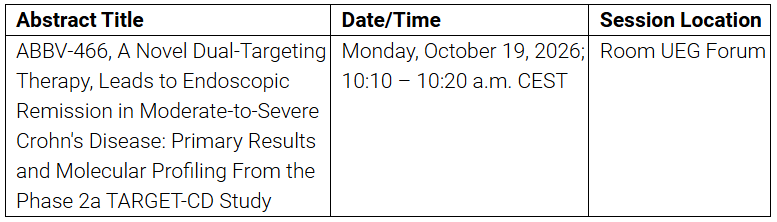
NORTH CHICAGO, Ill., Oct. 19, 2026 /PRNewswire/ -- AbbVie (NYSE: ABBV) today announced that its investigational ABBV-466, a novel dual-targeting therapy against IL-23 p19 and integrin α4β7, demonstrated higher rates of endoscopic remissiona at Week 12 than either monotherapy in patients with Crohn's disease (CD). The difference in endoscopic remissiona rates between ABBV-466 and monotherapy groups further increased at Week 24. The findings are from the TARGET-CD study, an ongoing open-label, treat-through, Phase 2a platform study in patients with moderate to severe CD.1,2 The findings will be presented as a late-breaking abstract at the ongoing 2026 Annual United European Gastroenterology Week (UEGW) Congress in Barcelona, October 17–20.
"ABBV-466 reflects how we are building the next generation of our inflammatory bowel disease (IBD) portfolio, leveraging insights from our own research to address disease pathways that may remain active even when a central inflammatory pathway is inhibited," said Kori Wallace, M.D., vice president, global head of immunology clinical development, AbbVie. "Our research pointed to evidence of α4β7-driven inflammation despite risankizumab's IL-23 p19 inhibition, leading us to augment risankizumab with a novel α4β7 inhibitor, trosunilimab. The TARGET-CD results reinforce our strategy of advancing therapies designed around the complex biology of Crohn's disease."
The TARGET-CD study included 300 patients (94, 100, and 106 patients in the anti-IL-23 p19 (risankizumab), anti-α4β7 (trosunilimab), and ABBV-466 treatment groups, respectively) with moderately to severely active Crohn's disease across the spectrum of disease severity and prior treatment experience. While 25% of patients were biologic-naïve, 75% had failed at least one advanced therapy, including 9.3% who had failed prior IL-23 therapy and 12% who had failed a JAK inhibitor; 25% had failed three or more advanced therapies. This patient population reflects the real-world complexity of Crohn's disease, where heterogeneous disease biology can contribute to differences in treatment response across patients.1
At Week 12, 30.2% of patients treated with ABBV-466 achieved the primary endpoint of endoscopic remissiona, compared to 21.3% and 18.0% of patients receiving anti-IL-23 p19 monotherapy and anti-α4β7 monotherapy, respectively. An improvement with ABBV-466 was also reported at Week 24, with 40.5% of ABBV-466 treated patients achieving endoscopic remissiona, compared to 22.4% and 20.0% of patients on risankizumab and trosunilimab monotherapy, respectively.1
Based on gene expression analyses, ABBV-466 showed colonic epithelial repair and barrier restoration at Week 12, followed by tissue remodeling and metabolic changes at Week 24 that were generally not observed with either monotherapy.1
"Many patients with Crohn's disease move from one advanced therapy to the next and still have active inflammation in the bowel, even when their symptoms improve," said Remo Panaccione, M.D., Professor of Medicine and Director of the Inflammatory Bowel Disease Unit, Division of Gastroenterology and Hepatology, University of Calgary. "Endoscopic remission is a goal we aim for, because ongoing inflammation can drive disease progression over time. What stands out in the TARGET-CD Phase 2a study is that a dual-targeting approach reached that goal more often than either therapy alone in a heavily pretreated population."
Rates of serious adverse events (SAEs) for ABBV-466 were 10.4% and comparable to risankizumab monotherapy (9.6%) and trosunilimab monotherapy (9.0%). In the ABBV-466 and trosunilimab monotherapy arms, the most common adverse events (≥5%) were Crohn's disease and nausea. In the risankizumab monotherapy arm, the most common adverse events (≥5%) were Crohn's disease and arthralgia.1
Additional information about the program can be found on clinicaltrials.gov under the identifier NCT06548542.
UEGW Presentation Details:
aDefined as Simple Endoscopic Score for CD (SES-CD) ≤4 and no sub score greater than 1 in any individual variable
About TARGET-CD
TARGET-CD (NCT06548542) is an ongoing open-label, treat-through Phase 2a platform study in patients with moderate-to-severe Crohn's disease. Patients were randomized 1:1:1 to receive 24 weeks of ABBV-466, risankizumab or trosunilimab. The primary endpoint was endoscopic remissiona at Week 12. Additional prespecified endpoints were assessed at Weeks 12 and 24, with safety assessed through Week 24. SES-CD is an assessment tool used during colonoscopy to measure the severity of inflammation and damage in patients with Crohn's disease.
About ABBV-466
ABBV-466 is an investigational dual-targeting therapy combining risankizumab, an IL-23 inhibitor, with trosunilimab, an α4β7 inhibitor, to address complementary drivers of inflammation in Crohn's disease. The approach is designed to inhibit inflammatory signaling while limiting immune-cell trafficking to the gut, with the goal of achieving deeper disease control than either pathway alone.
ABBV-466 is investigational, and its safety and efficacy have not been established by regulatory authorities.
About AbbVie in Immunology
AbbVie is relentless in our pursuit to redefine the standard of care for patients living with immune-mediated conditions, with the goal of helping them live a life free from the limitations of their disease. For nearly 30 years, AbbVie has led and helped shape the field of immunology through groundbreaking science and trusted medicines. Building on deep expertise across gastroenterology, rheumatology, dermatology and other areas of high unmet need, we continue to invest in a broad and differentiated pipeline – spanning innovative modalities, novel mechanisms of action and next-generation approaches designed to conquer the complex biology underlying immune-mediated disease.
Today, more than 1 million patients worldwide are treated with AbbVie's immunology medicines, approved in more than 175 countries across 20+ immune-mediated diseases that impact adult and pediatric populations. As we work to strengthen our legacy and drive the next wave of innovation, we remain focused on delivering meaningful progress for patients and expanding access to our medicines. For more information, please visit www.abbvie.com/immunology.
About AbbVie
AbbVie's mission is to discover and deliver innovative medicines and solutions that solve serious health issues today and address the medical challenges of tomorrow. We strive to have a remarkable impact on people's lives across several key therapeutic areas including immunology, neuroscience and oncology – and products and services in our Allergan Aesthetics portfolio.
References:
-
AbbVie. Data on file. ABVRRTI84181
-
Study of Targeted Therapies for the Treatment of Adult Participants With Moderate to Severe Crohn's Disease (Target CD). ClinicalTrials.gov. Available at: https://clinicaltrials.gov/study/NCT06548542. Accessed October 10, 2026.
-
SKYRIZI. Summary of product characteristics. AbbVie; 2026.