"In the United States, prescription drug pricing is an especially charged topic."In February 2026, Peter Kolchinsky, founder and managing partner of RA Capital Management, visited Shanghai to take part in the Leaders' Dialogue Seminar. During the event, Kolchinsky presented his book The Great American Drug Deal and shared his vision for affordable innovation.
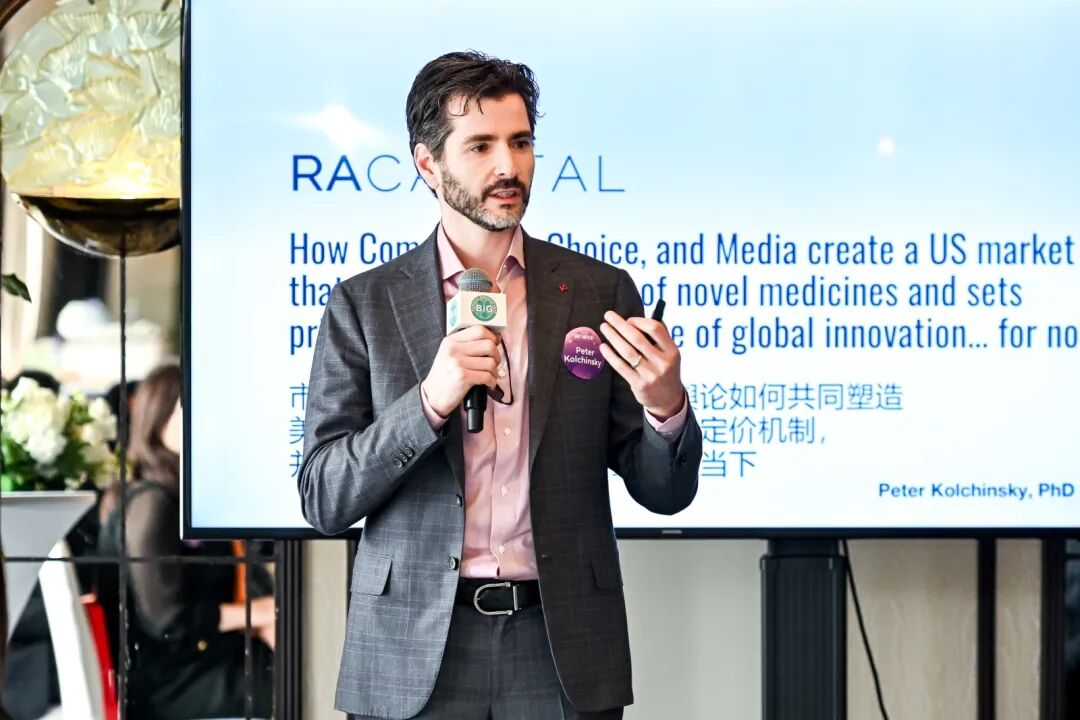
Peter Kolchinsky, Founder of RA Capital Management
The seminar was initiated by BiG (Biologics Innovation Group) and co-presented by RA Capital Management and PharmaDJ.
The core theme of this book, Kolchinsky said, is how to incentivize innovative medicine development while also ensuring that those medicines are accessible and affordable to the patients who need them.
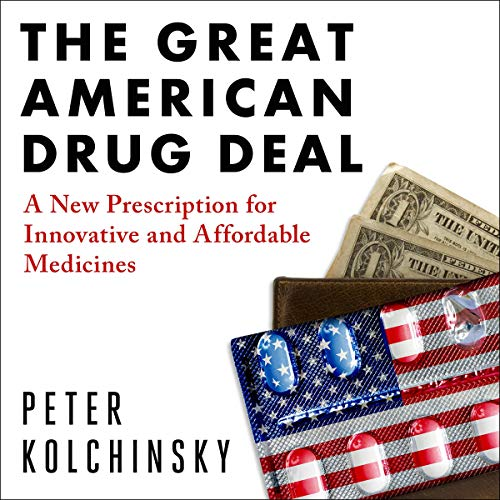
Trained as a virologist before becoming an investor, now Kolchinsky remains a scientist at heart. He loves the innovations he sees in China, America, Europe, and everywhere else, but he has also learned that companies are essential to turning breakthroughs into real medicines.
The Crisis That Prompted the Book
In 2015, the American public and politicians grew furious with the pharmaceutical industry, arguing that drug prices were too high compared to Canada, the UK, and Germany.
According to the Centers for Medicare & Medicaid Services, total U.S. healthcare spending reached approximately $5 trillion in 2025, or about $15,000 per person annually , while annual per capita prescription drug spending exceeded $1,400 . Healthcare spending in the U.S. remains the highest among wealthy countries. That’s almost twice as much as countries such as the UK, France or Australia, according to an analysis by The Commonwealth Fund.
Kolchinsky saw a serious threat. "Americans are frustrated about paying the highest prices in the world for medications on average, about twice as high as in other developed countries," Kolchinsky wrote in the foreword of his book.As an investor, he knows that if the US stopped paying, it could end his investments and halt innovation altogether.
Kolchinsky shares a personal story: his son has celiac disease, for which there is no cure. If the US will not pay for a future treatment, he cannot use his firm's capital,but only his own money. He cannot afford to bring such a drug to market alone. He needs the American public to believe in the value of new medicines and pay enough. As a husband, a father, he has watched loved ones battle illness, and those experience drive his determination to speed the arrival of new treatments.That is why he wrote his book.
The US Market as the Global Arbiter of Innovation
Kolchinsky argues that the US relies not on cost-effectiveness formulas (as in the UK) but on a distinct market-based system. Right or wrong, it is the only market Chinese innovators care about. When he asks Chinese scientists how they will fund their companies in Shanghai, they say they aim to partner with Merck, Roche, or venture capital to bring their drugs to America. They accept that China pays less. Kolchinsky is grateful for China's innovation as long as the early assets reach all markets.
The US system is built on choice. One insurance plan may deny certain drugs while a slightly more expensive plan covers them. Consumers choose. For example, Vertex earns about $8‑9 billion annually in the US from Trikafta (elexacaftor/tezacaftor/ivacaftor and ivacaftor), a cystic fibrosis treatment costing roughly $300,000 per patient per year. That translates to just $2 per person per month in insurance premiums. No plan is forced to cover Trikafta, but denying it would cause a public relations disaster. The American public has decided that paying for such drugs is preferable, and the market continuously tests what prices are acceptable.
Media, Public Outrage, and the Role of Employers
Media attention is crucial. When a plan denies a drug, public anger can lead employees to switch employers or plans, forcing the plan to reverse its decision. This dynamic constantly recalculates value. RA Capital employs over 200 people, many in commercial analysis, to understand which diseases and drugs matter to the American public. This knowledge guides their conversations with Chinese innovators, helping them focus on products likely to be valued in the US.
The Unconscionable to Deny Principle
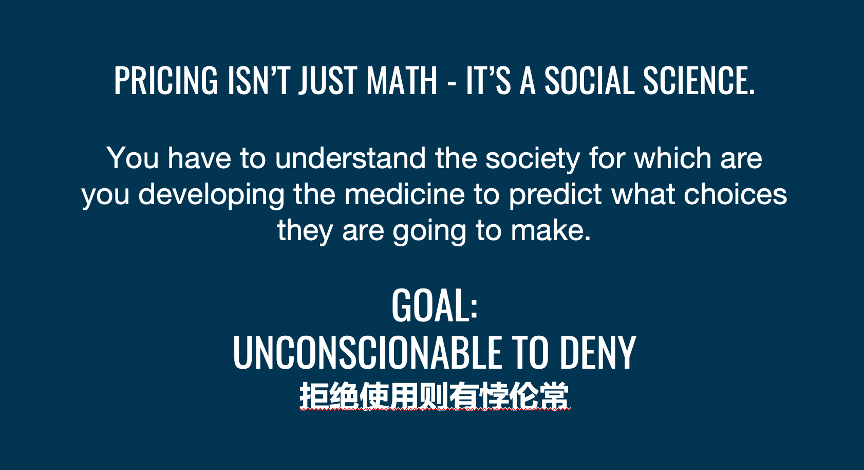
Kolchinsky offers a rule: if a drug does not save money in the short term, a plan will likely deny it unless the denial would provoke public outrage. For a first‑in‑class drug addressing a serious disease with no alternatives, the drug must be unconscionable to deny. That is where pricing power comes from. If competition exists, the drug must be cheaper. “Pricing is a social science, not just math. Investors must anticipate what society will find unacceptable to deny.” Kolchinsky believes.
In single‑payer systems (UK, Canada, Australia), a single decision maker sets prices, which are far lower than US levels,often 60‑70% below what US GDP per capita would suggest. These prices are insufficient to incentivize innovation. The US market provides 70‑80% of global drug profits and thus directs global R&D priorities. If the US adopted strict price controls, innovation worldwide would suffer.
The Affordability Misunderstanding
Novel medicines make up only 8% of total US healthcare, about $400 billion per year. Total US healthcare costs $5 trillion, or $1,260 per person per month. A $4 billion drug costs just $1 per person per month. If one plan denies the drug at $1,260 and another covers it at $1,261, the difference is negligible. The question is not affordability but value. Many Americans do not understand this; they are angry because insurance sometimes forces high out‑of‑pocket costs even though premiums already cover the medicine.
Kolchinsky writes about social contracts: affordability depends on proper insurance (paying through premiums, not out‑of‑pocket costs), and value depends on drugs going generic on time. The two main problems in America were insurance design that left patients with high costs, and delayed generic entry for biologics. The Hatch‑Waxman Act works well for small molecules, but biologics are hard to copy and their prices remained sticky.
Kolchinsky first proposed price controls after 15 years in a 2016 article. His book came out in 2020. The Inflation Reduction Act of 2022 introduced "Medicare negotiation",effectively price controls after 13 years for biologics and 9 years for small molecules. Kolchinsky argues that 9 years is too short for small molecules because the first 4‑5 years are spent launching the drug, cutting off the most profitable years. A proposed EPIC Act, would restore appropriate incentives.
Most Favored Nation and the Trump Administration
In 2026, Republicans propose a most favored nation policy: the US should pay no more than any other OECD country. Kolchinsky believes this would backfire. Innovators would focus only on the US, other countries would get no drugs, and US prices would actually rise. Chinese companies would simply develop two molecules, one for the US, one for the rest of the world at lower prices. He has discussed this with Trump administration officials, who admitted they had not considered that response.
When the prize is large, competition brings down prices. Hepatitis C drugs started at $84,000 for a 12‑week course and fell to $20,000 with competition. Trikafta costs $300,000 per year, but without it, cystic fibrosis patients incur over $100,000 annually in hospital costs, cannot work, and die in their 30s. Over 60‑80 years, the drug saves money. “This is like investing in clean energy or solar panels: higher upfront cost, long‑term savings.” Kolchinsky said.
What China Could Do
Kolchinsky suggests that as China’s economy grows larger and its people grow wealthier, how the country decides to pay for medicines will increasingly influence what kind of innovation-in China and globally-attracts funding.
“China could discover the right price by starting low and gradually raising it until investment appears. “He said. Investors would require forward contracts guaranteeing that price for the patent period, similar to defense industry procurement. The US offers no such guarantees, only the predictability that Americans will continue to value health, justice, and fairness for decades.
Kolchinsky is inspired by the progress in biomedical innovation over the past decade. Most drugs launched in China copy proven innovations, so success rates are high and margins appropriately lower (40% vs 200% in the US). True first‑in‑class innovation is a lottery: very few winners subsidize many failures. The entire pharmaceutical industry has only about 8% profit margins after $300 billion in annual R&D. A 10% global price cut would make the industry non‑profit; a 25% US price cut would do the same.
“With 1.4b people, if only China existed in the world and wanted to incentivize biomedical innovation as powerfully as the US market does, it would probably drug prices to be about 25% as high as they are now in the US. ‘That would be enough,’ said Kolchinsky. The question would be how those costs are apportioned across society.”
The Purpose of the Book
“If we stay true to the principle that no patient should be left behind—made possible by insurance in its many forms,then those cures will reach all who need them. That is the great deal we should all strive for: delivering innovative, affordable medicine for all,” he emphasized as the purpose of the book.
Kolchinsky wrote many articles starting in 2017, then spent a year turning them into a book with a narrative. His expectation is simple: that people understand where medicines come from, recognize the drug industry as a source of hope, and celebrate innovators. Public hatred of drug companies, if ignored, leads to policies that destroy incentives. Politicians may promise to punish the industry, but the result is fewer cures and higher long‑term costs. Leaders must sometimes do what is needed, not what is popular.
Kolchinsky told me that the hardest part was reorganizing all the chapters in a logical way, and that it required a tremendous amount of work. “I was thinking I was almost done,” he said with a smile, “only to be told I still had much more to do.”
In the end, Kolchinsky looks forward to partnering with Chinese innovators to advance affordable innovation. He hopes the US hears this message, that Europe appreciates it, and that as Chinese biotech grows stronger, its contributions will help sustain global innovation. He looks forward to seeing how China experiments with its insurance system, as advancing commercial health insurance reform holds great significant potential.