Reported by Jane Edited by:Jia Yao
At the 2026 ESMO Congress, the ADC story is no longer about isolated wins. It is a collective push across multiple targets, tumor types and treatment stages.
In first-line lung cancer, Kelun-Biotech and Merck’s TROP2 ADC went head-to-head with Keytruda plus chemotherapy and extended median PFS from 5.7 months to 15.0 months. In later-line gastric cancer, AstraZeneca’s CLDN18.2 ADC doubled median OS while substantially expanding the treatable population. Hansoh and MediLink, two globally leading B7-H3 ADC players, both read out positive Phase 3 data in tumors beyond lung cancer, while other global contenders crowded onto the stage.
Kelun-Biotech/Merck: TROP2 ADC presses its attack on first-line lung cancer
The race to set a new standard in first-line NSCLC is heating up.
Merck, which owns the nearly $31.7 billion-a-year pembrolizumab franchise, struck a deal with Kelun-Biotech back in 2022 to explore Keytruda plus the TROP2 ADC sac-TMT in first-line NSCLC and other settings.
In driver-gene-negative NSCLC, the OptiTROP-Lung05 study has already shown that sac-TMT plus immunotherapy can become a new standard for PD-L1-positive patients. Could the same combination strategy reshape treatment for PD-L1-negative patients as well? The OptiTROP-Lung06 results presented at ESMO answer that question with a clear yes.
OptiTROP-Lung06 is a randomized Phase 3 trial in Chinese patients with PD-L1-negative nonsquamous NSCLC. It compared first-line sac-TMT plus Keytruda with Keytruda plus pemetrexed/platinum head-to-head.
Compared with Keytruda plus platinum doublet chemotherapy, sac-TMT plus Keytruda significantly prolonged progression-free survival—15.0 months versus 5.7 months—reduced the risk of disease progression or death by 51%, doubled median duration of response to 13.6 months from 6.8 months, and showed a favorable trend in overall survival.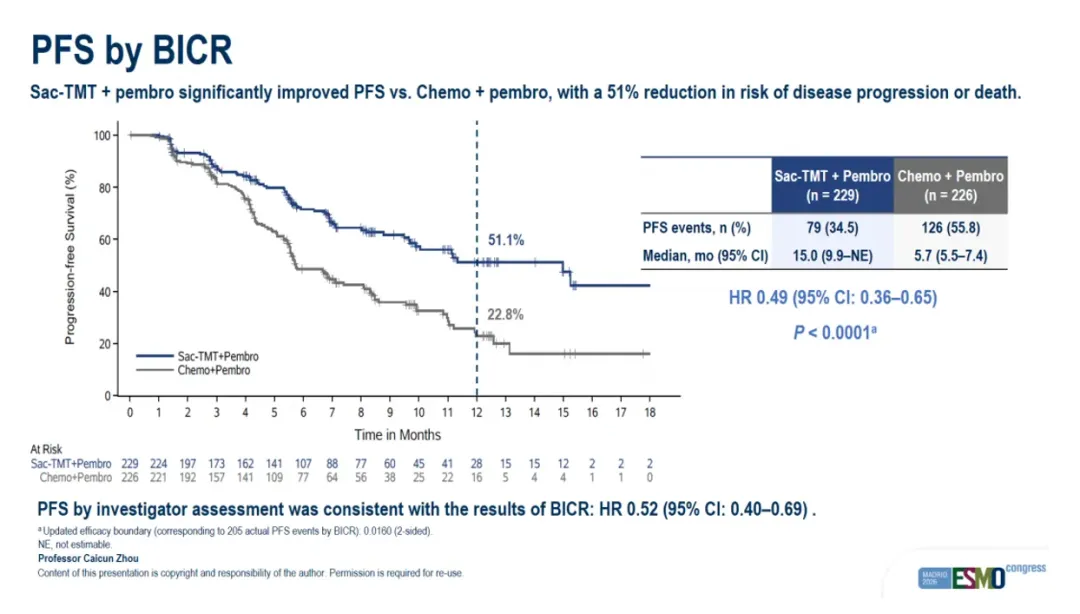
Source: Kelun-Biotech press release
Dara Azar, vice president of biotech equity research at Stifel, told BioSpace that OptiTROP-Lung06 was one of the ESMO reports likely to have major impact, calling the trial “a good case study” showing the potential of a combinable ADC to challenge platinum chemotherapy in first-line lung cancer.
The trial, led by Professor Zhou Caicun of Shanghai East Hospital, Tongji University, was simultaneously published in The New England Journal of Medicine. The paper noted that “the importance of OptiTROP-Lung06 is that it provides randomized Phase 3 evidence that a treatment strategy using an ADC to replace traditional chemotherapy while retaining PD-1 inhibition can significantly prolong PFS and change the occurrence of some treatment-related toxicities.”
The authors concluded that the study provides new high-level evidence for first-line treatment of advanced lung cancer and extends ADC research in lung cancer from later-line treatment into first-line combination therapy.
Sac-TMT already has four approved indications in China. Kelun-Biotech has launched nine registrational clinical studies in China, while Merck has started 18 Phase 3 trials globally across multiple cancer types.
AstraZeneca: CLDN18.2 ADC doubles survival
According to BioSpace, another ADC expected to make a splash at ESMO was AstraZeneca’s sonesitatug vedotin (Sone-Ve). AstraZeneca obtained global exclusive rights to the CLDN18.2 ADC in 2023 through a collaboration with KYM Biosciences, a joint venture between Lepu Biopharma and Keymed Biosciences.
AstraZeneca is evaluating Sone-Ve in the global Phase 3 CLARITY-Gastric01 trial in patients with CLDN18.2-positive advanced gastric cancer in second- and later-line treatment.
Early results released in July showed the trial met its primary OS endpoint in the third-line and later-line population, but the other primary endpoint—progression-free survival by blinded independent central review (BICR) in the overall trial population—showed only a trend toward improvement and did not reach statistical significance.
That was not an unambiguously positive result for AstraZeneca. Sone-Ve still needs full data to further explain its risk-benefit profile.
At ESMO, the data showed that in third-line and later-line treatment, Sone-Ve reduced the risk of death by 53% and doubled median OS to 10.0 months from 5.0 months. In the overall trial population, Sone-Ve reduced the risk of death by 42% and clearly extended median OS to 10.6 months from 6.4 months.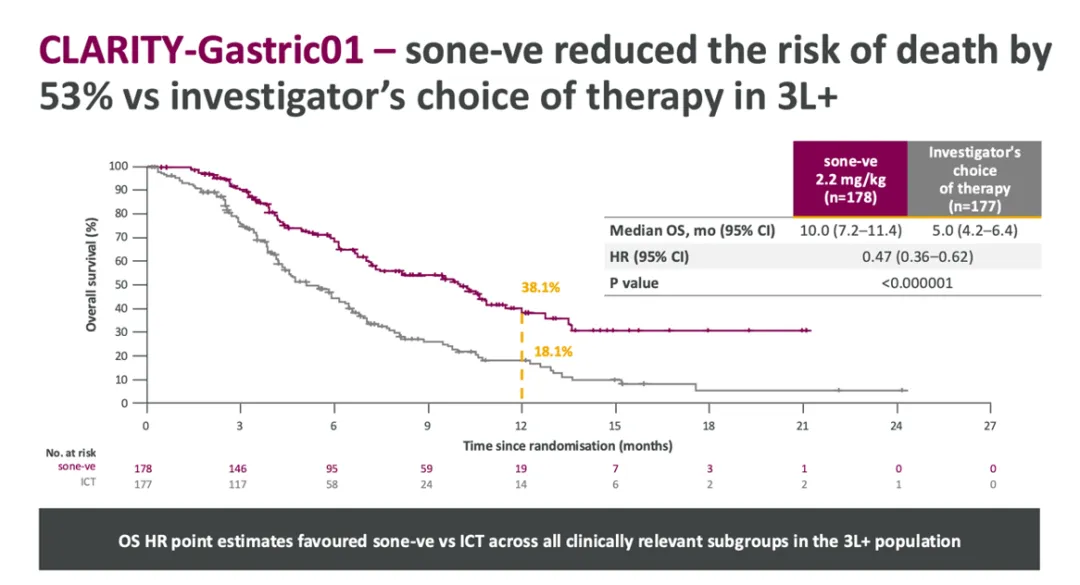
Source: AstraZeneca website
In the overall second- and later-line population, BICR-assessed median PFS was 4.2 months in the Sone-Ve arm, only 0.4 months longer than the control arm, and the difference was not statistically significant. Investigator-assessed PFS pointed to a clearer treatment benefit trend, with median PFS of 4.4 months for Sone-Ve versus 3.0 months for control.
Some experts interpreted the result by noting that discordance between PFS and OS is not uncommon in advanced gastrointestinal cancer trials. Clinical value cannot be judged by a single endpoint alone; patient characteristics, subsequent treatments and disease progression assessment all need further analysis.
Still, CLARITY-Gastric01 showed a step-change in efficacy magnitude in later-line gastric cancer. Doubling median OS exceeds the historical performance of most later-line studies. The trial also used a broader CLDN18.2 expression cutoff—requiring at least 25% of tumor cells to show membrane staining, compared with at least 75% for an approved monoclonal antibody—expanding the treatable population to about 60% of patients.
As Susan Galbraith, AstraZeneca’s global head of oncology R&D, said in a press release, “Sone-Ve sets a new survival benchmark for second- and later-line metastatic gastric cancer” and “has the potential to replace traditional regimens and become a new standard of care in this population.”
“As the first CLDN18.2-targeted therapy to show a survival benefit in this treatment population, Sone-Ve extended median OS by more than 4 months versus control and has the potential to change the treatment landscape for patients with CLDN18.2 expression,” said the trial’s principal investigator, Professor Xu Ruihua, director of Sun Yat-sen University Cancer Center.
Sone-Ve is expected to be filed simultaneously in China and the U.S. and could become the first CLDN18.2 ADC approved globally.
Beyond CLARITY-Gastric01, Sone-Ve is also in a Phase 3 study in first-line gastric cancer and Phase 2 studies of various combinations in pancreatic cancer, biliary tract cancer and other advanced solid tumors. Last month, AstraZeneca also teamed up with Summit to explore Sone-Ve plus Akeso’s PD-1/VEGF bispecific ivonescimab in multiple gastrointestinal tumors.
Hansoh and MediLink: the two Chinese B7-H3 ADC stars
B7-H3 ADC momentum carried over from WCLC to ESMO.
Hansoh Pharma’s Ris-Rez and MediLink Therapeutics’ Tam-Peli previously unveiled China Phase 3 data in second-line SCLC at the WCLC Presidential Symposium, delivering similarly positive results in similar treatment settings.
At ESMO, Ris-Rez was again selected for the Presidential Symposium and presented oral initial results from the Phase 3 ARTEMIS-011 study in osteosarcoma, further validating the B7-H3 ADC’s cross-tumor potential.
BICR-assessed median PFS was 5.5 months in the Ris-Rez arm versus 1.4 months for chemotherapy, a 67% reduction in the risk of disease progression or death. Benefit consistent with the overall population was observed across all prespecified subgroups. Objective response rate and disease control rate were both significantly better than chemotherapy. OS data were immature but already showed a numerical benefit trend.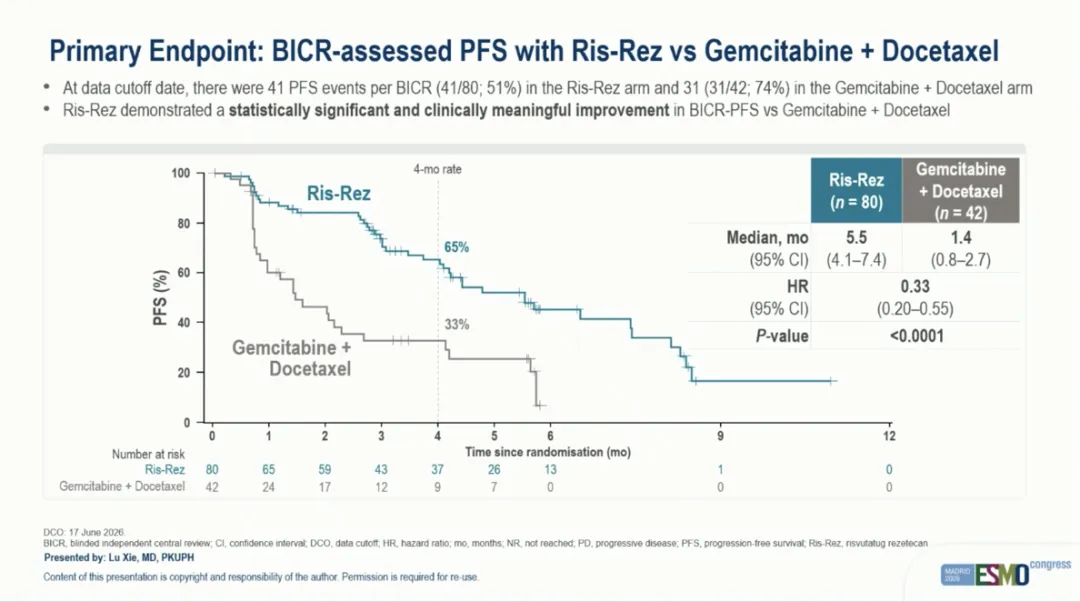
Hansoh’s partner GSK also brought multiple Ris-Rez datasets to ESMO.
The first global Ris-Rez data, from the EMBOLD PanTumour-101 study, showed a confirmed objective response rate of 61% in evaluable patients at the 8 mg/kg dose and 32% at 6 mg/kg. That further supports the positive data from the pivotal Phase 3 ARTEMIS-008 trial in Chinese SCLC patients.
MediLink’s Tam-Peli was selected for an ESMO LBA oral presentation and showed results from the Phase 3 TAISHAN-301 registrational study in heavily pretreated recurrent or metastatic nasopharyngeal carcinoma.
MediLink announced in May that the study’s interim analysis met its primary endpoint and noted that this was the first positive Phase 3 result for a B7-H3 ADC globally.
At the congress, data showed that in patients who had failed prior PD-(L)1 inhibitors and at least two lines of chemotherapy, Tam-Peli significantly improved confirmed ORR versus investigator’s choice chemotherapy—50.8% versus 25.8%—and also showed a treatment advantage in patients with poorer prognosis. The other primary endpoint, OS, and key secondary endpoint, PFS, were still immature at the data cutoff.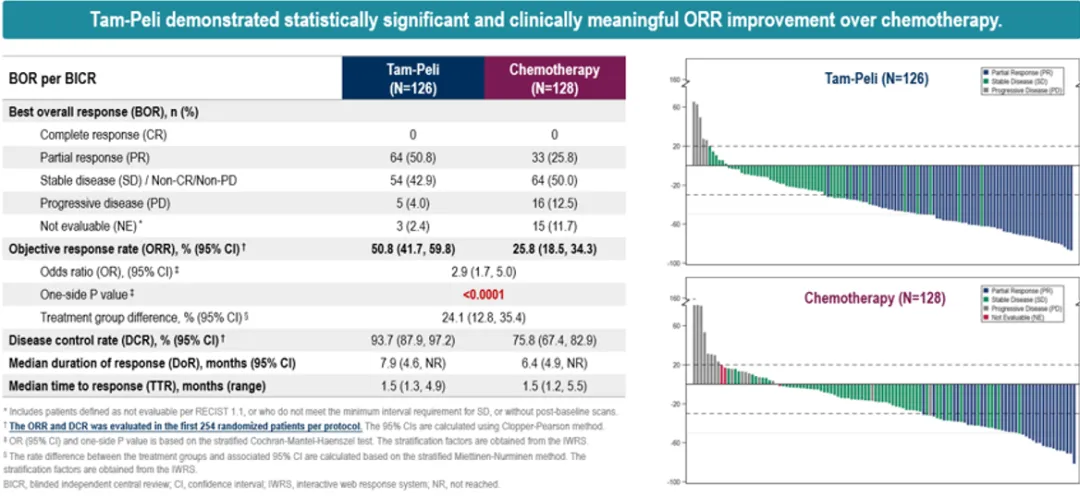
Source: MediLink Therapeutics press release
Both B7-H3 ADCs have been filed in China and included in CDE priority review, and both have been out-licensed to multinational companies. GSK obtained ex-China rights to Ris-Rez at the end of 2023, while Roche licensed Tam-Peli in early 2026.
B7-H3 ADCs are now red-hot, and companies are flexing their data at ESMO.
DualityBio presented the latest global Phase 2 data for Elfe-D. Elfe-D plus the PD-L1/VEGF-A bispecific pumitamig showed antitumor activity in multiple advanced solid tumors beyond lung cancer, with an unconfirmed ORR of 42.9% in hepatocellular carcinoma and 80.6% in platinum-resistant ovarian cancer.
Innovent presented first data from the international multicenter Phase 1 study of its EGFR/B7-H3 ADC IBI3001, showing encouraging antitumor activity and a manageable safety profile in heavily pretreated solid tumors. Overall ORR was 30.2%, and ORR reached 45.0% in the 8 mg/kg cohort.
MacroGenics also presented interim Phase 1 data for MGC026 in advanced solid tumors. In dose escalation, 17 efficacy-evaluable patients who received at least 6 mg/kg across 10 tumor types had a confirmed ORR of 29% (5/17) and a disease control rate of 65%.
Several other products also appeared at the meeting, including CSPC’s SYS6043, Qilu Pharmaceutical’s MHB088C and Merck/Daiichi Sankyo’s ifinatamab deruxtecan.
From later-line to first-line, from combination with chemotherapy to replacing chemotherapy, and from breast and lung cancer to a broader range of tumors, the ADC attack line is expanding in both depth and breadth. The next reshaping of lung cancer and gastrointestinal cancer treatment will clearly be defined by combination strategies pairing ADCs with immunotherapy, chemotherapy and other therapies.
The ADC race: challenging Keytruda, doubling OS, and a B7-H3 crowd | 2026 ESMO
·11/02/2026
Article keywords: ESMO
Download