*GSK's bepirovirsen became the first approved drug to clear the virus's surface antigen after treatment stops. In China — home to nearly a third of the world's cases — ASO, siRNA, capsid and vaccine candidates are already in late-stage trials, and combination regimens have become the field's consensus.*
GSK's bepirovirsen made history in August and October, becoming the first drug approved to deliver a functional cure for chronic hepatitis B. The bigger story may be in China: the country with the world's heaviest hepatitis B burden now has a crowded pipeline of antisense oligonucleotide (ASO), siRNA, capsid and therapeutic-vaccine candidates in late-stage trials, with developers increasingly betting that combinations — not single drugs — will be needed to make cures durable.
The GSK results set the benchmark. The B-Well 1 and B-Well 2 trials enrolled more than 1,800 people across 29 countries; after 24 weeks of treatment and follow-up through week 72, 19% of patients with baseline hepatitis B surface antigen (HBsAg) at or below 3,000 IU/mL achieved a functional cure — sustained HBsAg loss after stopping therapy. Standard treatment with nucleos(t)ide analogues and interferon suppresses the virus but produces functional cure in fewer than 1% of patients and usually requires lifelong dosing.
In the China subgroup the rate was 24%, rising to 61% among patients with the lowest baseline antigen levels (100–200 IU/mL), which Hou Jinlin, principal investigator of the trial's China arm, said exceeded expectations.
Hou said genotype is strongly associated with functional cure. About 30% of Chinese chronic hepatitis B patients carry genotype B, and in GSK's Phase 2b B-Clear study those patients had the lowest baseline HBsAg of any genotype and the steepest declines — a virological basis for the stronger Chinese result.
He also pointed to a more vigorous immune response: in the B-Well China subgroup, 39% of patients had alanine aminotransferase (ALT) elevations above three times the upper limit of normal, versus 24% globally. Such flares typically appear five to ten weeks into treatment, accompany rapid HBsAg decline and resolve on their own after dosing stops. They are not drug-induced liver injury. "We believe it reflects an immune system being activated and clearing the virus," Hou said, adding that patients who experienced these flares went on to achieve functional cure at higher rates.
Chinese developers are pursuing at least four distinct mechanisms. In ASOs, AusperBio's AHB-137 has completed Phase 3 enrollment of more than 570 patients, after a Phase 2 trial reported clinical cure in 70% of patients with baseline HBsAg of 100–1,000 IU/mL; an earlier candidate from Amoytop Biotech, ACT201, has shown stronger preclinical HBsAg suppression than bepirovirsen.
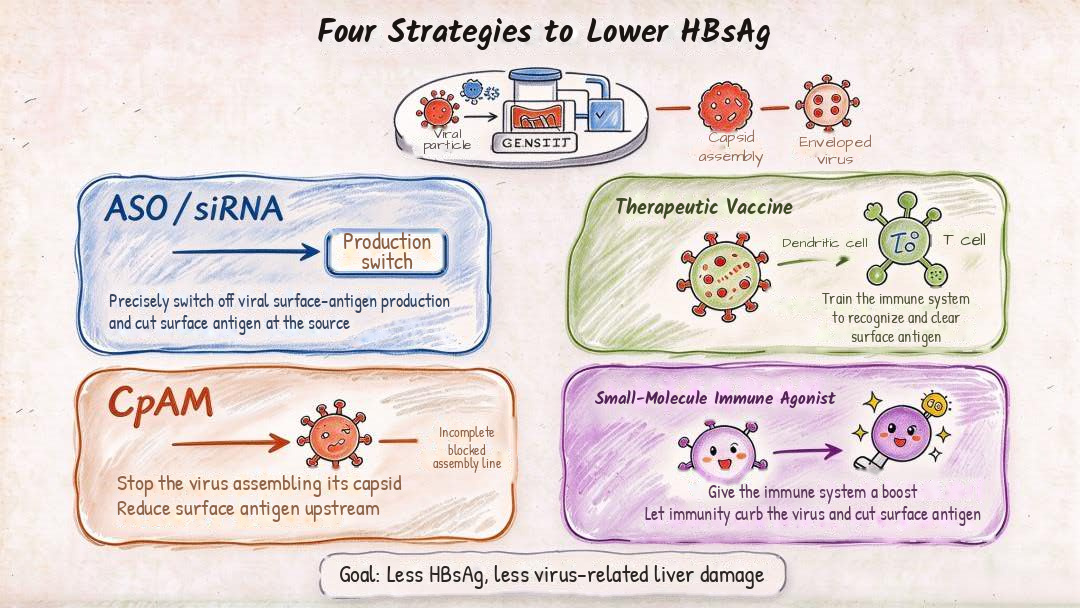
In siRNA, Hengrui's HRS-5635 entered Phase 3 in May, reportedly the first hepatitis B siRNA worldwide to do so — Phase 2 data presented at AASLD 2026 showed 16% HBsAg clearance at week 48 on 400 mg every four weeks, rising to 19% after 24 weeks off treatment. At least five other siRNA candidates are in Phase 2, from HepaThera (HT-101), Suzhou Ribo Life Science (RBD1016), Brii Biosciences (BRII-835), Argo Biopharma (BW-20507) and Chia Tai Tianqing (TQA3038).
Other routes are advancing in parallel. Cosunter's capsid assembly modulator GST-HG141 has completed enrollment of 578 patients in Phase 3, with Phase 2 showing HBV DNA suppression above 80% at week 24; Zhimeng Biopharma's ZM-H1505R is also in Phase 3, reporting a complete virological response of 82.1% when combined with entecavir, against 14.3% for the nucleoside analogue alone.
Grand Theravac Life Science's TVAX-008, described as the first therapeutic hepatitis B vaccine designed specifically for functional cure, has dosed its first Phase 3 patient, while Brii Bioscience's BRII-179 has reported Phase 2b topline results. A TLR7 agonist from Chia Tai Tianqing, TQ-A3334, recently received a breakthrough-therapy designation in China.
Across all of them, the strategy is converging on combinations. A 2024 *New England Journal of Medicine* study from a Chinese research team found that an siRNA followed by pegylated interferon achieved 23% HBsAg clearance, rising above 30% in patients with low baseline antigen.
GSK itself is testing bepirovirsen sequenced with an siRNA and with pegylated interferon. Chinese trials now pair ASOs with therapeutic vaccines, siRNA with neutralizing antibodies, and even three oral agents targeting antigen production, cccDNA and viral replication at once.
At EASL 2026, HepaThera's pairing of HT-101 — a GalNAc-conjugated siRNA that shuts down antigen production — with HT-102, a fully human neutralizing antibody that accelerates clearance of circulating HBsAg, reported HBsAg clearance of up to 90% at week 24 and 50% after 24 weeks off therapy. The dual-mechanism "suppress and clear" approach delivered striking, but early, data.
Most of those combination results come from Phase 2 or earlier trials, and longer follow-up, larger datasets and affordable pricing remain open questions. Bepirovirsen is not yet approved in China; GSK has said it expects a decision in mid-2027. By then, the country's own late-stage candidates may be close behind — setting up a contest in the world's largest hepatitis B market.