China is setting more ambitious targets for its pharmaceutical industry, marking a strategic shift from growth driven by industrial scale to innovation-led development under its 15th Five-Year Plan.
“China has made significant progress in narrowing the innovation gap with the US, Yang said. “Compared with ten years ago, when the gap between China and the United States was eightfold, it is now only 1.6-fold,” speaking at ChinaTrials18, Yue Yang, a professor and doctoral supervisor at Tsinghua University's School of Pharmaceutical Sciences, said China's pharmaceutical development is moving toward what she described as “absolute innovation.”
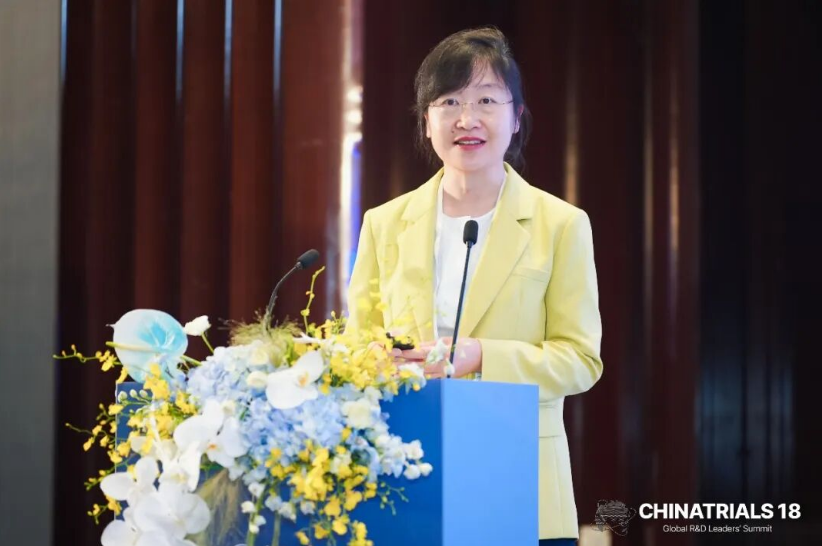
Yue Yang, a professor and doctoral supervisor at Tsinghua University's School of Pharmaceutical Sciences
Unlike the 14th Five-Year Plan, which placed greater emphasis on growth-rate targets, the new plan sets more concrete, outcome-oriented benchmarks. These include raising China's global share of first-in-class drugs to at least 25%, launching more than 200 innovative medical devices over the five-year period and increasing annual operating revenue among pharmaceutical enterprises above designated size to more than RMB 3.5 trillion. China also aims to rank among the world's leading countries in the number of drug development programs entering their first clinical trials.
China now accounts for 31.1% of the global investigational drug pipeline, making it the world's second-largest contributor, according to Yang. Biomedicine has also been explicitly designated as a strategic emerging industry in China's national development blueprint.
The pharmaceutical industry's ambitions are part of a broader economic transformation. The outline of the 15th Five-Year Plan sets a goal of bringing China's per capita GDP to the level of moderately developed countries by 2035. Yang noted that this would accelerate the timeline by roughly 15 years compared with the original mid-century vision articulated by Deng Xiaoping in 1987.
Against this backdrop, biomedicine, high-end medical devices and cutting-edge biotechnology have been identified as priority areas for development.
From Frontier Technologies to Clinical Translation
Beyond setting industrial targets, the plan places greater emphasis on strengthening the foundations of original innovation and accelerating the translation of scientific discoveries into clinical applications.
Among the frontier technologies highlighted are organoids and organ-on-a-chip systems, gene editing, precision molecular delivery, and cellular programming and regulation. Yang noted that organoids and organ-on-a-chip technologies have also been incorporated into the NMPA's recently issued NMAs plan, reflecting their growing importance in pharmaceutical research and development.
The plan also calls for artificial intelligence, quantum computing and supercomputing to be integrated into pharmaceutical R&D, with the aim of improving efficiency across the drug development process. It encourages broader use of real-world studies (RWS) in evaluating medicines throughout their life cycles, while strengthening comprehensive clinical assessments and the translation of research findings into clinical practice.
Clinical infrastructure is another priority. The plan calls for research hospitals to take the lead in establishing high-level clinical trial sites, while optimizing clinical trial protocols and ethics review procedures to shorten trial start-up timelines.
It also encourages the adoption of unified hospital information system (HIS) standards, the digitalization of clinical trials and greater connectivity between regulatory review and inspection systems.
The plan also places a clear emphasis on internationalization. “The 15th Five-Year Plan clearly states that pharmaceutical manufacturers shall be supported to conduct international multi-center clinical trials (MRCTs) and international registration for innovative drugs, and to expand overseas R&D bases and sales networks,” Yang said.
Data Protection and Market Exclusivity
With innovative drug development requiring substantial investment and carrying considerable clinical and commercial risks, China is also seeking to strengthen intellectual property protection and provide greater commercial incentives for companies developing innovative medicines.
Yang outlined several key provisions governing data protection and market exclusivity.“The core of data protection covers data generated during clinical trials,” Yang emphasized.
Market exclusivity runs in parallel with data protection rather than being added cumulatively. Innovative drugs for rare diseases, as well as innovative drugs and foreign-originator products launched in China for the first time, may qualify for seven years of market exclusivity.
The framework also introduces additional incentives for pediatric medicines. Innovative drugs and foreign-originator products first launched in China can receive an additional two years of exclusivity. Already marketed drugs that add pediatric indications, new dosage forms or new specifications may qualify for an additional year.
Yang stressed that pediatric exclusivity is conditional on conducting clinical trials, with the additional exclusivity period taking effect after the data protection period.
The regulatory framework also aims to accelerate clinical development. Under NMPA Announcement No. 86, clinical trial applications for IND can complete review and approval within 30 working days after acceptance.
Regulatory Alignment and AI Move Up the Agenda
China's regulatory framework is also moving further toward international alignment, with a series of clinical trial policy updates introduced over the past year.
Yang pointed to the revised 2026 Good Clinical Practice (GCP) requirements and the implementation of ICH E6(R3), which applies to drug clinical trials initiated after March 31, 2026. ICH M14, which addresses the use of real-world data in pharmaceutical safety assessment, is also part of the evolving regulatory framework.
Meanwhile, the Center for Drug Evaluation (CDE,NMPA) has issued multiple guidance documents on real-world studies and clinical evaluation, providing further direction for the use of real-world evidence in drug development and regulatory decision-making.
Artificial intelligence is emerging as another important component of China's pharmaceutical development strategy. These include using AI to assist in the review and scientific assessment of clinical trial protocols, as well as combining digital twins with AI-based predictive models to develop high-fidelity virtual patient models and simulate disease progression.