Key takeaways
· Market exclusivity protects the indication market, not the molecule. Competition in a different indication is not blocked.
· Regarding Linkage with Trial‑Data Protection Periods, Pediatric drugs “stack” and rare-disease drugs “run in parallel”; regulators have calibrated the effective exclusivity of both to a 7–8 year band. That is deliberate strength calibration, not a legislative oversight.
· License deals must move the Royalty Term anchor from “patent expiry” to “the latest of patent, data protection and exclusivity”, and add risk-allocation clauses for exclusivity that is never granted or is terminated.
· Exclusivity solves “time”, not “price”: the biggest uncertainty lies not in the term but in the supply obligation and reimbursement.
Author: Long Cheng
Editor: Jia Yao
This article was translated with AI assistance. To read the original Chinese version, please click here.
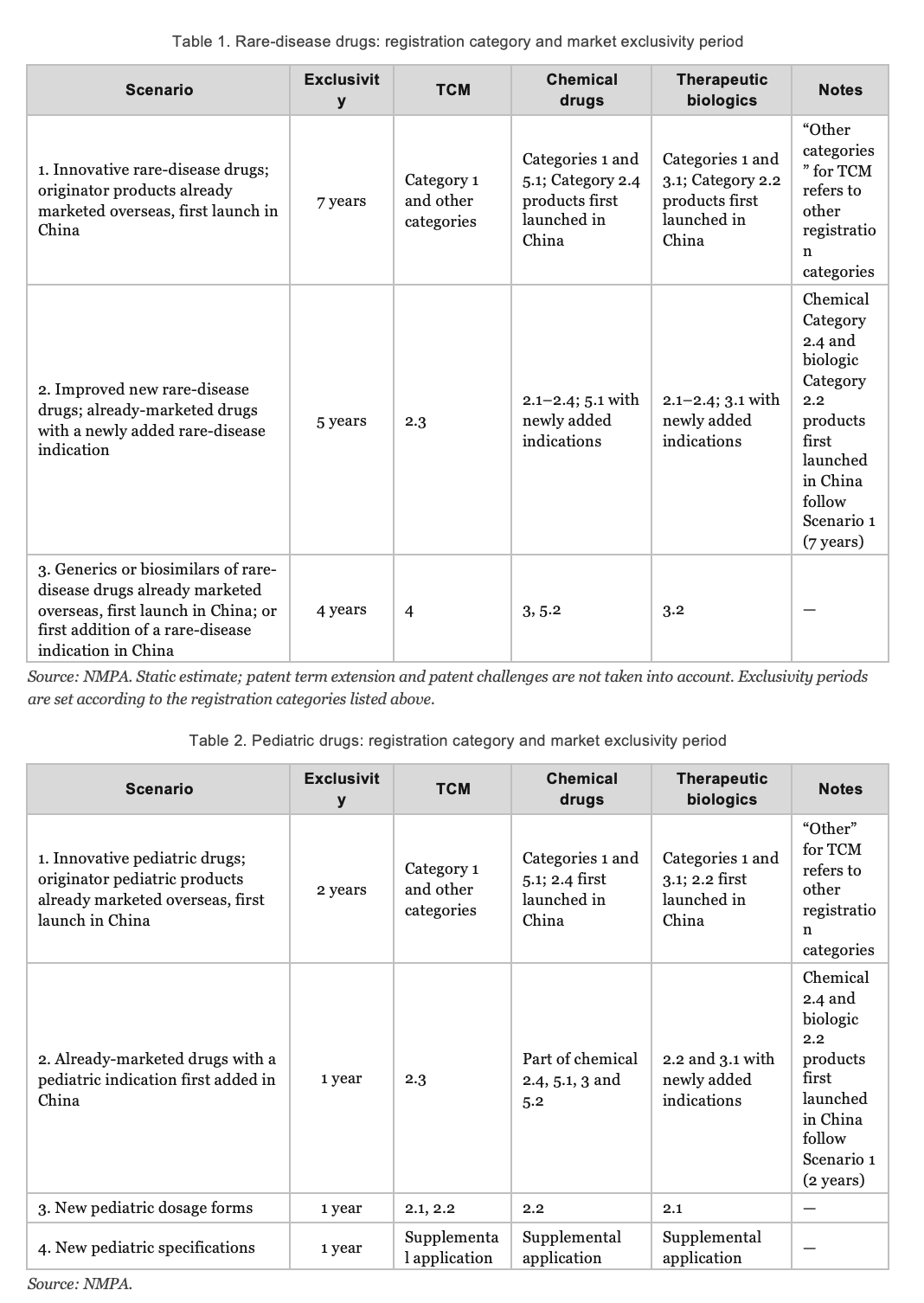
Recently, the China’s National Medical Products Administration (NMPA) released the Measures for the Implementation of the Drug Market Exclusivity Period (Draft for Comment), covering rare-disease drugs and pediatric medicines (the “Draft”). “Exclusivity” means that, during the term, marketing authorisations and supplemental applications for competing products of the same variety will be rejected — even if the competitor does not rely on the protected trial data and completes the entire clinical programme on its own.
The exclusivity period is not only an R&D incentive. It will reshape registration strategy, pharmaceutical intellectual-property (IP) layout, the competitive arrangement between innovative and generic drugs, and how value is assessed in BD transactions.
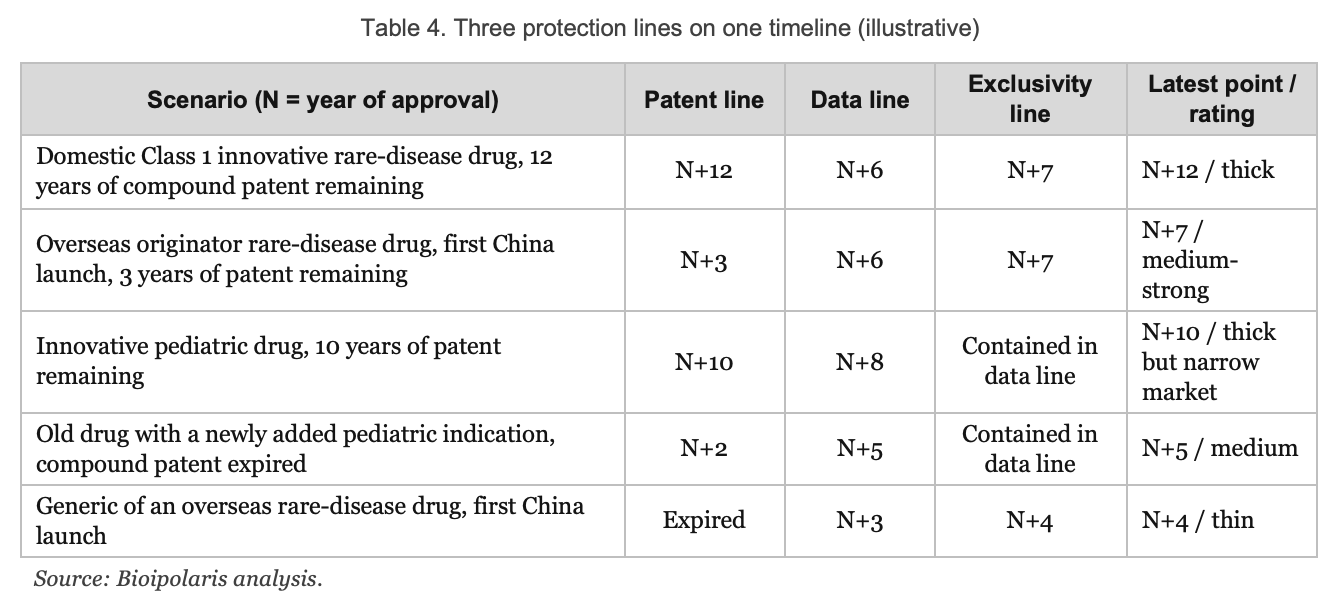
“R&D, IP and regulatory teams inside a company need one unified view of the protection cycle: plot each product’s patent (including term extension), trial-data protection and exclusivity as three lines on a single chart, and mark the latest protection point and the regulatory tail.” Lily Wang, founder and CEO of Bioipolaris, told PharmaDJ. What companies should do, she argues, is not stretch all three lines, but stagger their expiry so the product moat gets deeper.
A deliberately different linkage to data protection
The Draft links market exclusivity to data protection differently for the two product types: for rare-disease drugs, the exclusivity period runs in parallel with the trial-data protection period (where one already exists); for pediatric drugs that have already obtained, or simultaneously obtain, data protection, the market exclusivity period is to be stacked after the corresponding data protection period. The two product types are also granted different terms.
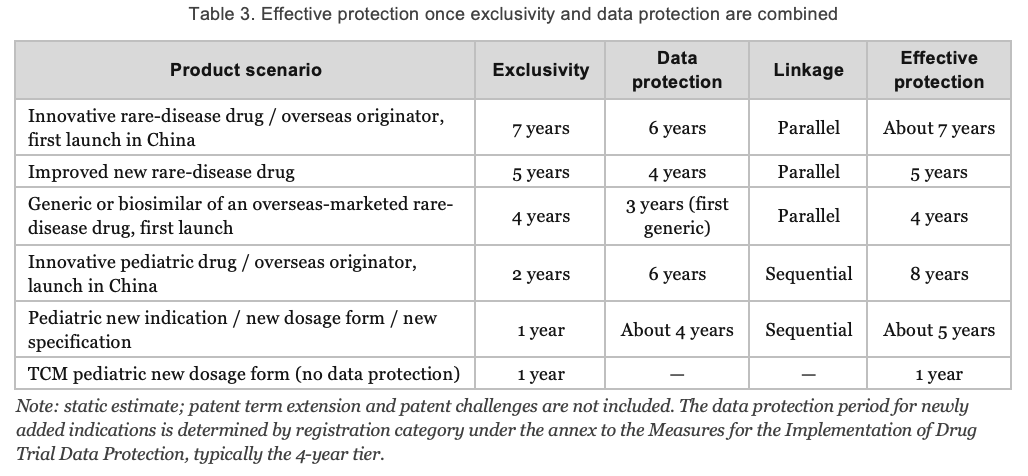
“An innovative rare-disease drug gets ‘a seven-year period you can price’; a pediatric drug gets ‘one to two years that can be stacked’. The first is enough to change an asset’s return model; the second only improves the marginal incentive and can hardly support a go/no-go decision on its own.” Lily is the former head of IP at Novartis, WuXi Biologics, Ascentage Pharma and early-stage biotechs, with 18 years of experience in biopharma patent consulting; Bioipolaris specialises in full-lifecycle patent management for new drugs, global IP portfolio design, licensing transactions and technology transfer.
Under the Draft, seven years of exclusivity for an innovative rare-disease drug and six years of data protection run in parallel and are counted as seven years — broadly enough to cover the payback cycle from launch to ramp-up. Many rare-disease compound patents expire simultaneously in China and the United States; because the China launch comes later, only three to five years of patent life typically remain. Exclusivity can hard-block competitors at the approval gate and build a moat beyond the patent.
Lily also believes that the three-year gap between the exclusivity granted to overseas originator rare-disease drugs and to generics, both first launched in China, gives the originator a stronger incentive to launch in China first — which lifts the bargaining position of China rights.
“Companies must recognise clearly that market exclusivity solves only the time window, not the price problem. A seven- or eight-year exclusivity period does not automatically translate into commercial returns; the ultimate return still depends on NRDL negotiation, provincial landing and patients’ ability to pay. Policy dividends need patent barriers, clinical value, supply-chain capability and a commercial system to hold them up together.”

Lily Wang, founder and CEO of Bioipolaris
For pediatric drugs, two years of exclusivity can stack onto data protection to reach eight years; a new indication, a new dosage form and a new specification each earn one year, stacking to about five years. Pediatric bridging studies usually cost tens of millions of renminbi and take three to five years, so one year of exclusivity may not cover the investment; the real commercial logic remains reimbursement differential pricing, tender grouping and brand. “So for pediatric drugs, the clearer beneficiaries are innovative pediatric drugs and ‘rare-disease plus pediatric’ crossover products,” she says.
In Lily’s view, the differentiated design exists to calibrate incentive intensity for the two product types. “If a two-year pediatric exclusivity ran in parallel with six-year data protection, it would be swallowed whole and the policy would idle. Turning it into a sequential 6 + 2 = 8 years is what lets the two years create real increment. Conversely, if seven years of rare-disease exclusivity were stacked on six years of data protection, total protection would stretch to 13 years — far beyond the US (7), the EU (10) and Japan (10) — over-extending the monopoly and pushing up reimbursement spending.”
Second, the two types differ in the character of their innovation: pediatric drugs are mostly new dosage forms, specifications or added indications of already-marketed products — low risk, short cycle, one to two years is enough for a marginal incentive; rare-disease drugs are mostly originator innovation with high failure rates and hard recruitment, so seven years is what covers the risk.
“Data protection is soft protection — competitors can design around it; exclusivity is a hard block. The design aims at complementarity of effect: pediatric drugs use the hard block to top up soft protection, while rare-disease drugs run in parallel because seven years already covers six and needs no stacking. The end goal in both cases is to match the effective term to the level of risk.”
The staggered-expiry strategy
The drug market protection system is built on patent protection, trial-data protection and market exclusivity. Lily sees the three as “a property wall, an anti-free-riding wall and an approval gate” — a combination in which none can substitute for another.
“To strengthen a product moat, companies should not stretch all three lines; they should let them expire at staggered points. The core metric of moat strength is the ‘regulatory tail’ — only when three to five years of exclusivity remain after patent expiry can the commercial protection expectation be called complete.”
Three tests define the moat. Length: a latest protection point at least 10 years from approval, or at least three years of exclusivity after patent expiry, counts as strong. Width: patents must cover all indications and the main dosage forms, whereas exclusivity covers only the same variety and cannot stop cross-indication competition. Hardness: exclusivity outranks data protection, because varieties protected only by data can be designed around.
Three Criteria for a Defensive Moat
- Duration: Strong protection if the latest‑expiring protection point falls ≥10 years after approval, or if ≥3 years of market exclusivity remain post‑patent expiry.
- Breadth: Patents must cover all indications and major dosage forms. Market exclusivity applies only to the same variety and cannot block cross‑indication competition.
- Robustness: Market exclusivity outweighs trial‑data protection. Products with trial‑data protection alone can be circumvented via self‑generated clinical data.
Lily sets out three operational levers.
First, designing the interface between protection periods. A patent term runs 20 years from filing, while exclusivity runs from approval — the two are naturally misaligned. For innovative rare-disease drugs, companies should lay crystal-form, formulation, process and use patents alongside the compound patent, so that the patent endpoint sits as close as possible to the far end of “six years of data protection plus seven years of exclusivity”. That avoids either a gap in which the patent has expired while exclusivity still runs, or one in which exclusivity is exhausted while the patent continues.
Second, progressive indication filing. Article 14 of the Draft states that one application may seek only one exclusivity, but where different indications are approved at different times, each indication’s exclusivity is calculated separately. Companies can therefore launch an adult indication first and file rare-disease or pediatric indications later as supplemental applications, locking exclusivity in segments and, in effect, extending total protection. This is the most operationally valuable clause in the draft and should be designed upfront, at the pipeline-planning stage.
Some products carry “rare disease plus pediatric” dual eligibility. “This is not an arithmetic question of seven versus two; it is a question of how you design the filing unit,” Lily says. “The optimal solution is probably to split the two eligibilities across different filing units.”
“Four variables drive the decision: population size and ability to pay, remaining patent life, the competitive landscape and the deal structure. If the advantage sits mainly in the pediatric indication, take pediatric exclusivity; if mainly in the adult indication, take rare disease; if the two weigh equally, consider a split filing path. When out-licensing, the ownership of the ‘choice of exclusivity type’ and the tiered milestones must be spelled out.”
Third, secondary patents combined with new specifications and dosage forms. A new pediatric dosage form or specification earns one year of exclusivity on its own, and “same specification” is required for same-variety status. A combination of formulation patents and design patents around delivery devices, taste-masking coatings and dose units can upgrade a bare specification change into a protection layer with some barrier.
Companies also need to watch infringement closely. The “same variety” test uses an all-elements-identical standard: same generic name, same active ingredient or TCM formula, same dosage form, and same indication or therapeutic function (plus the same specification in the case of new pediatric specifications). On that basis, changing only the dosage form or specification may fall outside “same variety” and permit approval during another company’s exclusivity period.
She recommends dynamic, multi-dimensional monitoring: “edge” filings that change dosage form or specification; supplemental applications for new indications (which may be either workarounds or fresh exclusivity applications); and first generic filings in China for products already marketed overseas (the 4-year tier). Companies should also track the exclusivity notices published on the CDE website and the annotations on approval certificates, fold them into routine freedom-to-operate and competitor early-warning lists, and cross-check the choice of declaration type in the patent-linkage process against exclusivity status.
What it does to BD valuations: the anchor moves
In license-in/out and co-development transactions, the market exclusivity period may become a material driver of a product’s commercial value. Lily believes the Royalty Term anchor will have to shift from “patent expiry” to “the latest of patent, data protection and market exclusivity”, with a new allocation of the risk that exclusivity is not granted or is terminated.
The effect differs by asset. Where substantial patent life remains, exclusivity is redundant protection and the buyer should not pay extra for it. Where patents are about to expire or have already expired, exclusivity becomes the main source of value, extending the exclusive sales window in China by three to seven years — the real beneficiaries of this round of policy dividend. Pediatric improvements carry short terms, but the stacked tail covers the market-cultivation period.
Reverse discounts must be priced in too: termination for supply breach, failure of the out-of-catalogue justification, same-variety disputes, and reimbursement price cuts. Exclusivity is an administrative grant rather than a property right, so its stability is lower than that of a patent.
On that basis, Lily suggests five points to get right in the contract terms. First, separate “patent term” from “regulatory exclusivity term” and use the later expiry as the reference. Second, step the royalty rate down when the patent expires and exclusivity begins (commonly to 50–70% of the base rate), then step down again or terminate when data protection ends. Third, terminate at patent expiry if exclusivity is never granted, and terminate early or reprice if it is terminated for supply breach. Fourth, add milestones or extend the term when a new indication obtains independent protection. Fifth, calculate the China term separately from other regions.
Beyond the terms, diligence has to establish whether the product has a strong moat that can support the value ascribed to exclusivity. The markers are: patents covering all indications with at least eight years remaining, or at least three years of exclusivity continuing after patent expiry with secondary patents to follow. In diligence, the three lines belong on one timeline, not in three separate tables.
“The core of deal diligence should move up from ‘is there exclusivity’ to ‘is it obtainable, maintainable, enforceable and transferable with the deal’. Two items remain deal-breakers: failing to apply at the same time as the marketing application (Article 12 — no supplementary application is possible), and lacking the capacity to guarantee supply.”
The “beachhead” opportunity?
The Draft is intended to encourage rare-disease and pediatric development, and leaves room for development strategy — for example, a beachhead strategy.
A beachhead strategy uses a narrow segment (rare disease, or pediatric rare disease) as the first approved indication, wins marketed status quickly, and then expands outward into large indications such as oncology and autoimmune disease. “There is a benefit, but it is a tactical window, not a strategic moat,” Lily told PharmaDJ.
The value lies in priority review and conditional approval, which allow a first approval on a small sample. It also allows a company to set a high-price anchor early and to use post-marketing real-world data to inform the design of large-indication trials.
The limits are equally clear. First, one application selects one indication, and exclusivity locks only that indication; competitors developing the same molecule in oncology or autoimmune disease are unconstrained. Second, clinical costs and competitive intensity in large indications far exceed those in rare disease — being first to market does not necessarily mean first to hold the position. Third, regulators may be wary of artificial indication splitting, and clearing the out-of-catalogue justification for a rare-disease exclusivity application is difficult. Fourth, payment linkage: negotiations in large indications will reference rare-disease pricing. Fifth, the supply obligation is a hard constraint — if large-indication volume crowds out capacity and causes a shortage of the rare-disease drug, exclusivity may be terminated.
“Exclusivity should therefore be treated only as cash-flow protection for the first indication. Lay the patent foundation early (compound or sequence coverage across all indications), widen the use patents, and bring large-indication registrational trials forward before the rare-disease or pediatric launch — otherwise the first-mover advantage will be consumed by a three-to-five-year clinical cycle. If the plan is to out-license the large-indication rights, complete the molecule-level licence before the rare-disease or pediatric launch, so that the licensing chain does not become tangled once the indications are split.”
What could still change in the final version
Lily notes that the Draft still leaves substantial room for refinement. From discussions with industry experts and practitioners, she distilled the main strands of feedback on the current text:
· The 12-month first-generic exclusivity is hollowed out. Patent-linkage first-generic exclusivity requires being first to challenge successfully and first to be approved; if the originator is still inside its market exclusivity, the generic cannot be approved and the clock cannot start. The applicable sequence should be clarified, or the period restarted after expiry.
· “Same variety” includes the indication, which makes the scope narrow. The same molecule competing in an adjacent indication is unconstrained and “new use of an old drug” is the most exposed. For rare disease, the US “same drug” standard (by active ingredient) is suggested as a reference.
· The start date sits ahead of commercialisation. NRDL access, provincial listing and hospital entry lag by one to two years, compressing the effective exclusivity period. Counting from first sale, or a green channel for market access, could be explored.
· Termination for supply breach lacks procedural safeguards. A rectification window with termination only after it lapses, and a clear definition of force majeure, are suggested.
· There is tension between “one exclusivity” and indication-specific counting. It should be clarified that separate applications may each be filed, and “strategic filing” should be defined.
· The out-of-catalogue justification is insufficiently predictable. The composition of experts, the deliberation deadline and publication of conclusions are unspecified; detailed rules or an illustrative list are suggested.
· The transition for existing same-molecule products and conditional approvals needs clarity: whether supplemental applications are blocked, and how commercialisation costs are treated after withdrawal.
Beyond the protection dividend, supply is an important institutional consideration of market exclusivity — a safeguard against companies using shortages or withdrawal to force price increases. In Lily’s view it has three purposes: balance of consideration (an approval-side exclusivity right must be exchanged for stable supply); prevention of abuse (rare diseases have few substitutes and the social cost of a shortage is extremely high); and access first (at this stage, whether a drug exists at all matters more). The supply requirement is stronger than in the US, EU and Japan: those jurisdictions typically revoke the designation or shorten the protection period, whereas China makes “failure to honour the commitment” a ground for termination outright.
She notes, however, that the standards and procedures remain contested: how to define “failure to perform” — deliberate or objectively unavoidable shortage; how long a shortage must last; whether there is a rectification period and a hearing; whether terminating seven years of exclusivity for a single regional shortage is proportionate. All need detailed rules. Moreover, the supply obligation applies only to rare-disease drugs, which is asymmetric with pediatric shortage risk; whether to include pediatric drugs should be considered.
Lily flags several variables in the final version that may ultimately determine how much of the dividend materialises: whether the “same variety” definition is adjusted; whether pediatric drugs gain a supply obligation and term optimisation; whether the identification and procedure for supply breach are refined; whether medical insurance and commercial insurance can form a supporting payment channel; and how “same variety” and “new indication” are defined in practice for the first batch of exclusivity products.