As geopolitical tensions increasingly shape the global biopharmaceutical industry, particularly with the U.S. House Select Committee releasing the report titled "Prescription America: How To Protect Americans from a Dangerous Dependence on China for Their Medicines" on November 23, 2026, Chinese drugmakers face an increasingly complex path to international markets. China's growing role in global drug innovation, coupled with mounting U.S. scrutiny of Chinese clinical data, is forcing companies to reassess their global development strategies.
At ChinaTrials18, hosted by PharmaDJ, three panelists — Miranda Li, head of IQVIA's International Regulatory Strategy team in China; Melissa Mannion, Of Counsel at Jones Day and former Senior Regulatory Counsel in FDA’s Center for Drug Evaluation and Research; and Dr. Yaning Wang, former director of the Division of Pharmacometrics in the FDA's Office of Clinical Pharmacology discussed the implications of the U.S. government's Operation TrialBlazer initiative. Their discussion examined the issue from three perspectives: industry strategy, legal and regulatory compliance, and regulatory science.
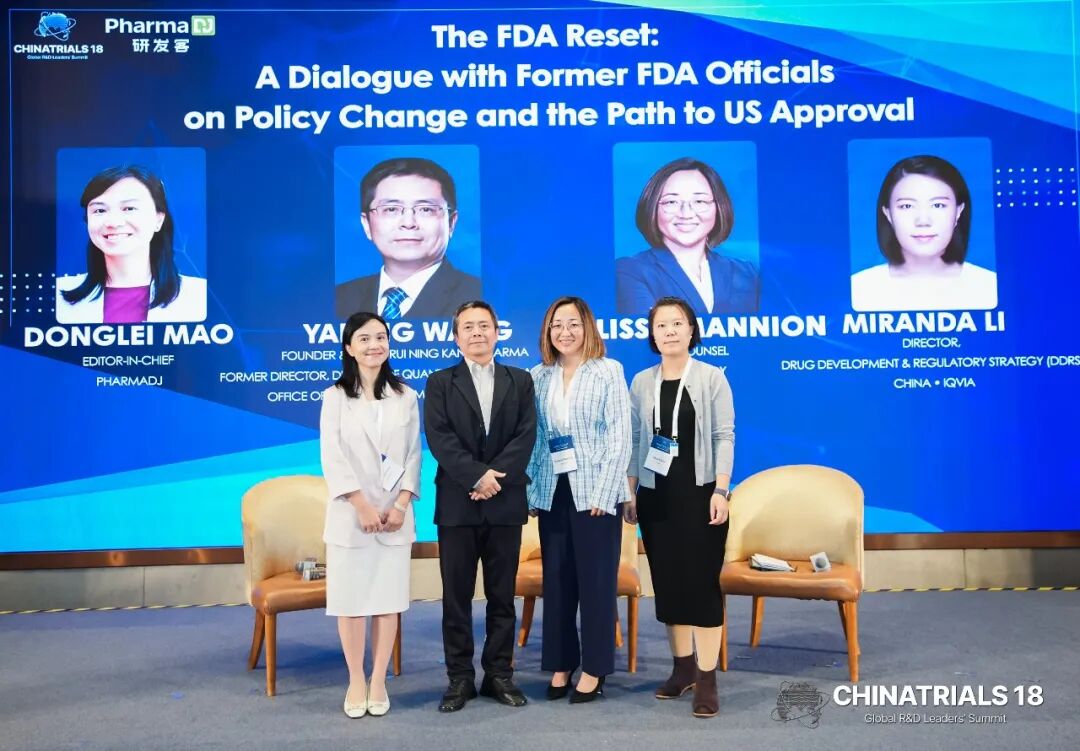
Donglei Mao the chief editor of PharmaDJ, and Miranda Li, head of IQVIA's International Regulatory Strategy team in China; Melissa Mannion, Of Counsel at Jones Day and former Senior Regulatory Counsel in FDA’s Center for Drug Evaluation and Research; and Dr. Yaning Wang, former director of the Division of Pharmacometrics in the FDA's Office of Clinical Pharmacology
The Policy and Regulatory Drivers Behind Increased U.S. Scrutiny
The changing competitive landscape may help explain some of Washington's growing concerns. According to figures cited during the discussion, Chinese-origin drugs accounted for 48% of globally approved innovative drugs in 2025, compared with less than 5% five years earlier.
Against this backdrop, Operation TrialBlazer, an initiative associated with the U.S. Department of Health and Human Services (HHS), aims to address broader concerns about America's position in global biopharmaceutical innovation. The Emerging Biotechnology National Security Commission has warned that the window for the U.S. to take decisive action is measured in years rather than decades.
Addressing an amendment proposed by the U.S. House Appropriations Committee that would restrict the use of Chinese clinical data in IND applications, Miranda Li said the proposal cited concerns about data reliability, research ethics and data ownership. However, she suggested that the broader policy considerations, including national security and technological competitiveness, may also inform the proposal.
She also noted that some industry sources have questioned the fairness of some of the proposal's characterizations of China's clinical research infrastructure, particularly claims that Chinese clinical sites operate outside independent jurisdiction and do not accept FDA inspections.
Miranda suggested that one objective of the U.S. policy shift seems to be to encourage global drug developers to conduct clinical research in the U.S. at an earlier stage, thereby preventing a potential shift of early-stage clinical development capabilities toward China from undermining the U.S. innovation ecosystem.
Despite these concerns, the panelists considered the prospect of a comprehensive legislative ban on Chinese clinical data relatively low. Moreover, a blanket exclusion of Chinese clinical data would represent a significant departure from the existing regulatory framework under 21 CFR.
The proposed legislative amendment remains a proposal and is not binding statutory text. It passed the House by a narrow 213-210 vote and still faces considerable uncertainty in the Senate.
That does not mean, however, that the FDA will maintain its current approach without adjustment.
"Although I don't think this proposal will become law, the political pressure is considerable, and some policy changes may be implemented internally, making it more difficult for the FDA to accept data or trials conducted in China," Dr. Wang said.
He noted that FDA reviewers have increasingly begun to examine where clinical trials are conducted, with particular attention to institutions in China that may present military affiliations or other sensitivities.
Miranda similarly emphasized that the FDA continues to accept Chinese clinical data as a regulatory matter. Nevertheless, she warned that a broader tightening of the evidentiary threshold for accepting such data is highly likely and is already becoming apparent in regulatory practice.
The uncertainty is compounded by a period of significant leadership turnover at the FDA.
Melissa presented a chart illustrating recent changes among the agency's senior leadership. Dr. Wang pointed to staff departures and shifts in policy direction at the U.S. FDA as contributing to the uncertainty, although several current senior officials, including the acting FDA commissioner and the heads of CDER and CBER, continue to be regarded positively by industry.
The FDA's Internal Transformation: Faster Reviews and New Regulatory Methodologies
While tightening its scrutiny of foreign clinical data, the U.S. is also seeking to strengthen its global position through domestic regulatory reform and scientific modernization.
Melissa said the FDA has, at times, implemented policy changes more quickly and through less traditional channels, such as announcements at medical conferences or press briefings, rather than through notice-and-comment rulemaking and guidance. More recently however, FDA appears to be relying more on conventional rulemaking and guidance processes while continuing to advance its efforts to modernize clinical trials.
One major area of change is the growing adoption of New Approach Methodologies (NAMs). Melissa noted that more than 90% of drug candidates that demonstrate safety in animal studies ultimately fail in human trials. Against this background, the FDA is encouraging the use of alternative approaches, including AI-based predictive models and organ-on-a-chip technologies, to reduce reliance on animal testing, particularly studies involving non-human primates.
"Pharmaceutical companies do not necessarily need to validate these new methodologies. What matters is whether they can adequately address the relevant toxicological concerns to support approving an IND for a first-in-human study," she explained.
The FDA has issued guidance, including General Considerations for the Use of New Approach Methodologies in Drug Development, addressing the application of these approaches beyond small-molecule drugs. Congress has also indicated that the methodologies should be applicable to biologics.
The agency has additionally established a NAMs Database of Use Case Examples, providing both successful and unsuccessful case studies to help companies understand how these approaches may be applied in drug development.
Melissa also referred to the establishment of a new FDA office intended to advance the integration of artificial intelligence and real-world evidence (RWE) into drug development. The office was identified in the discussion as the Office of Innovation and Clinical Trial Modernization (OICTM).
Beyond alternative methodologies, the FDA is also revisiting its approach to drug approval and clinical development.
Melissa said the agency has formally adopted a framework under which one high-quality late-stage clinical trial, supported by confirmatory evidence, can serve as the basis for new drug approval. Such confirmatory evidence may include real-world data or mechanistic evidence.
For first-in-human (FIH) studies, the FDA has introduced the Expedited IND Pilot Program, which incorporates Qualified Research Institutions (QRIs) into a rolling submission process, alongside guidance on quantitative systems pharmacology (QSP). These initiatives are intended to shorten clinical trial start-up timelines by six to 12 months.
The agency is expected to soon release a Clinical Trial Enrollment Action Plan, which may shift FDA’s expectations for clinical trial populations to better reflect the diversity of the intended U.S. patient population — a development that could further encourage multinational clinical trials (MRCTs). The document is currently with the White House for review.
Another initiative worth watching is ARPA-H's SURPASS program (Simulation-augmented, Real-time Platform Adaptive Seamless Trials). According to Melissa, the program is exploring the use of AI-powered digital twins, shared clinical trial infrastructure and even so-called "phaseless clinical trials" to reduce the number of participants required and lower development costs.
The Growing Compliance Burden for Chinese Drugmakers
Alongside efforts to accelerate drug development, the FDA is strengthening its regulatory oversight and enforcement activities.
Melissa advised that the agency is increasingly using AI-driven, risk-based approaches to select clinical trial sites and manufacturing facilities for inspection, while conducting more unannounced inspections at overseas research facilities. The Bioresearch Monitoring (BIMO) program is also expected to place greater emphasis on early-stage clinical trials.
The FDA has further signed a new memorandum of understanding with the U.S. Securities and Exchange Commission (SEC) to facilitate the sharing of non-public information.
Meanwhile, the agency's Transparency Roadmap is intended to make more regulatory documents publicly accessible, including Form 483 observations and Establishment Inspection Reports (EIRs). The FDA is also considering greater disclosure of clinical study reports (CSRs) submitted by drug developers, potentially bringing its level of transparency closer to that of the European Medicines Agency (EMA).
Melissa stressed that clinical data alone are not sufficient to secure regulatory approval.
"If you focus exclusively on clinical data and overlook the manufacturing quality of your product, you could face enormous risks to its commercial prospects," she said.
Citing Hengrui Pharmaceuticals' receipt of three Complete Response Letters (CRLs) as an example, she emphasized that successful drug approval depends on both clinical evidence and compliance with current Good Manufacturing Practice (cGMP) requirements.
"Even if you outsource manufacturing to a third party, you, as the sponsor, remain responsible for any problems at the manufacturing facility. Ultimately, you are the company bringing the product to market." Drug sponsors should regularly check in with their contracted manufacturing facilities and maintain active oversight of those activities to prevent undesired, cGMP-related surprises from inspections.
On inspection preparedness, Melissa recommended that companies begin building FDA inspection readiness as early as the clinical trial design stage, rather than treating it as a task to be addressed shortly before an inspection.
For Chinese companies seeking to take early-stage assets global, Miranda highlighted two particularly important challenges: dose selection and ethnic differences.
"The FDA does not provide a step-by-step playbook. Ultimately, the question is whether your data are sufficient to support their applicability to the U.S. population," she said.
Companies therefore need to conduct rigorous analyses based on differences in standards of care and clinical practice between China and the U.S., rather than approaching the FDA with broad or insufficiently substantiated theories.
INDs and IITs: Understanding the Fundamental Differences Between the Two Systems
The discussion also highlighted some of the differences between the Chinese and American clinical research systems.
Dr. Wang pointed to growing U.S. interest in China's progress in cell and gene therapy (CGT). Cell therapy pioneer Carl June, for example, has previously suggested that the FDA could learn from China's dual-track clinical research system, particularly its investigator-initiated trials (IITs).
However, Dr. Wang cautioned against drawing direct comparisons between the two countries' regulatory frameworks.
He explained that China's IIT system emerged from the country's particular regulatory history and was the result of an arrangement between the Center for Drug Evaluation (CDE) and the National Health Commission. Its regulatory requirements differ from those governing the IND pathway. The U.S., meanwhile, does not have an equivalent regulatory pathway.
In his view, comparing China's IIT system with the U.S. IND system amounts to "comparing apples to oranges."
"Under the IND pathway, China is actually slower than the U.S. It is primarily the advantages in cost and speed that have attracted Phase I trials to China," Dr. Wang said.
He emphasized that the FDA's scientific review teams continue to evaluate data on their scientific merits. As long as companies can demonstrate that the data are applicable to the intended population and that there are no clinically meaningful ethnic differences, the agency can accept clinical data generated outside the U.S.
However, Dr. Wang also raised concerns about the safety challenges facing China's increasingly innovative drug pipeline, particularly as China aims to achieve 25% of global, first-in-class development by 2030 and more companies shift focus to developing more novel therapeutics, for which the first-in-human studies inherently carry higher safety risks.
He recalled a serious early-stage clinical trial incident that happened in the TGN1412 case in Europe. That Phase I trial, which resulted in severe adverse reactions among participants, prompted significant changes in the approach to first-in-human dose selection, including greater reliance on the Minimum Anticipated Biological Effect Level (MABEL) principle rather than approaches based primarily on safety factors.
Developing novel therapeutics requires careful balancing of speed, risk tolerance and safety. Policy changes that accelerate clinical trials to expand treatment options for patients with high unmet medical need are commendable, but greater speed or risk tolerance must never come at the expense of patient and participant safety. "If such a tragedy occurs, the regulatory thinking in both China and the U.S. will inevitably change, and oversight of early-stage clinical trials will become more stringent," he said, referring also to serious adverse events recently disclosed in Chinese IITs.
Rethinking the Global-from-Day-One Development Strategy
Against a more complicated international regulatory backdrop, Chinese innovative drugmakers need to reconsider how they design global development programs from the outset. Those that build cross-border collaboration into their strategies early on can shorten development timelines thereby working to bring novel therapeutics to patients faster.
Miranda recommended that companies developing products with potential in the U.S. market move away from the traditional "China first, bridge later" approach. Instead, they should incorporate global regulatory requirements into their development plans from the earliest stages of R&D.
In practical terms, this means aligning non-clinical development with FDA requirements as early as possible. Chinese Phase I data can still provide valuable evidence on safety, dose selection and ethnic applicability. However, when planning Phase III development, companies should give greater consideration to MRCTs as China-only pivotal trial data may not provide sufficient evidence for generalizability to U.S. patients to support FDA approval.
Miranda also identified a common misconception among Chinese companies in their interactions with the FDA: treating the Pre-IND meeting primarily as a procedural step rather than an opportunity to obtain meaningful regulatory advice.
She encouraged companies to engage with the agency early, once sufficient preliminary data are available, and to use these discussions to clarify development requirements and address potential regulatory concerns.
At the same time, companies should take advantage of the FDA's current initiatives to accelerate FIH development, including opportunities to streamline certain CMC and toxicology requirements where applicable.
In the closing discussion, Miranda noted that the FDA, as a federal agency, operates within a broader policy environment and its regulatory mission depends on maintaining scientific integrity while fulfilling its responsibilities as a government agency.
Melissa similarly emphasized the importance of the FDA's continued participation in international regulatory platforms, such as the International Council for Harmonisation (ICH), as well as its ability to keep pace with advances in science and technology.
Closing the session, Mao Donglei, editor-in-chief of PharmaDJ and moderator of the discussion, called for continued cooperation between the two countries.
"Politics may have borders, but science and the welfare of patients do not. I hope China and the U.S. will continue to cooperate in the life sciences," she said.