With its PanFlex engineering technology, BiBo Pharma hopes to ramp up biologics manufacturing in half the time for half the cost to serve growing biotech startups that need a hand.
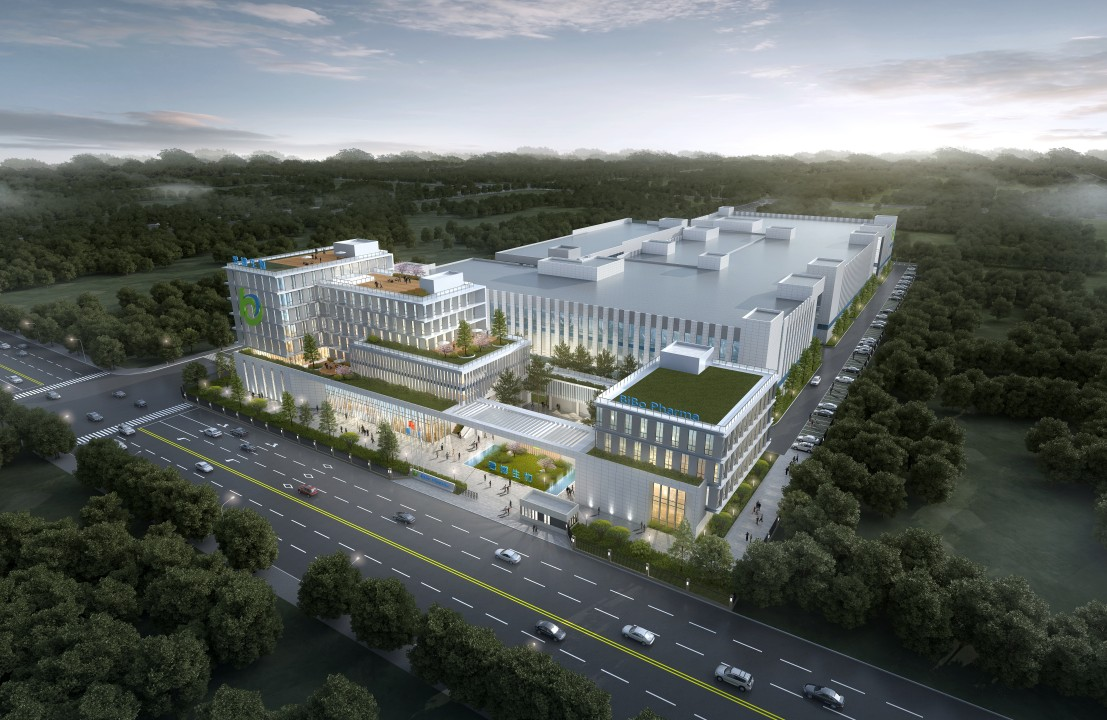
BiBo Biopharma held a groundbreaking ceremony in the Lingang New Area of the Shanghai Pilot Free Trade Zone in August 2021.
BiBo Pharma is new to China’s contract development and manufacturing organization (CDMO) industry, but it has ambitions to be a game-changer, building the world’s largest facility.
The project, named P03 and located in Shanghai, has a total planned minimum capacity of 200,000 liters. It will include “the world's first stainless steel single mammalian cell production line with a capacity of 30,000 liters in total volume,” the company said in late August.
“We expect to complete it in the fourth quarter of 2022,” BiBo CEO Jiao Peng told PharmaDJ in an exclusive interview. “We’ve been working on large-scale manufacturing. Our team has experience building 20,000L production lines with 25,000 to 27,000 liters in total volume. We’d like to move one step further to increase the volume by 20%.”
BiBo boasts its speed in building its facilities, and it has a proven track record. The company spent 147 days to finish building P02, which Jiao called “record-breaking.”
P02 is another integrated production platform for biologics with a total capacity of over 20,000 liters. It comes with GMP production platforms covering mammalian cell culture, microbial fermentation, gene therapy and fill-and-finish.
This time, BiBo expects to complete P03 in 18 months.
Half the time and cost
The key to building these facilities so fast lies in its PanFlex-Engineering system, which Jiao said also helps the company pursue the biggest stainless steel production lines.
“Pan” means meeting all kinds of requirements clients may have, and “Flex” stands for flexible, referring to BiBo’s capability to allow clients to switch production scale or processes for different products.
A big challenge, Jiao said, is keeping the facilities flexible. It is easy to do so with a 2,000L single-use bioreactor, but not with a 30,000L or even a 20,000L stainless steel bioreactor. This requires innovation at the engineering level.
“Unlike the conventional method, the PanFlex-Engineering system adopts a different approach. Producing drug, protein or antibody products requires different processes, which we divide into different unit operations. These unit operations will act as elements and be put together based on the clients’ needs,” he said.
He explained that these elements are called layer-one structures. When put together, they form the layer-two structures as processes, then become layer-three when put in 3D locations. This makes for a bottom-up approach for building up a facility– unit operations growing into processes, then into buildings and finally a factory – different from the conventional approach that first builds a building and then different rooms.
“By building facilities this way, we will eventually increase facility usage, which means we can reduce the cost,” Jiao said. “We already have a number of processes and we will have five or six different unit operations as base elements. Those will be built simultaneously before we combine them together. So overall, the time will be cut down by half.”
Large-scale stainless steel for lower costs
In the CDMO industry, the use of large-scale stainless steel in biologics manufacturing has been catching on in the U.S. and Europe. It helps lower the manufacturing costs for commercialization.
For a long time, single-use bioreactors have been the choice for many. They’re best for clinical-stage products as they offer more flexibility and take less time and money to build.
“However, the operation cost is high as a lot of materials are consumed and it’s hard to scale up past 5,000 liters. The biggest single-use bioreactor we see now is 5,000 liters, and most use 2,000L or even smaller bioreactors,” Jiao said.
“When a product moves to the commercial stage, companies will need large-scale manufacturing facilities if they want to reduce the cost. Stainless steel becomes a must,” he added.
A 20,000L stainless steel bioreactor, for example, can cut the cost down to one-fourth or one-fifth per gram for protein products compared to a 2,000L single-use bioreactor.
Acute need in China
China has an acute need for large-scale manufacturing using stainless steel.
“In China, most players use 2,000L or smaller bioreactors and mostly for clinical development,” Jiao said. “As more products are nearing commercialization, we really need to build up large-scale manufacturing capabilities to fulfill commercial needs, and there’s a huge gap at the moment. We don’t see a lot of companies with this capability.”
By 2020, the total capacity from mammalian cell production lines in the U.S. and Europe was over 7.2 million liters, but it still trailed demand by 3 million liters. In China, the capacity was just close to 200,000 liters by the end of 2019.
“We estimate that by 2029, this demand in China will reach 15 million liters ” Jiao said. “From 0.2 million liters to 15 millions of liters. That’s a big gap.”
As Chinese biotech companies start to commercialize their biological drugs, manufacturing costs will play a crucial role in their survival.
“If companies only rely on 2,000L single-use bioreactors, the cost of every gram of their product will be high. There will be no chance for most products to survive on the market,” he said.
Grow with smaller players
Biotech startups have been sprouting up all over the world, and Jiao believes some of them have promising pipeline products that could reach the global market. However, these small players lack the capability or capital to ramp up large-scale manufacturing capacity, and bigger CDMOs already have long lists of clients.
With its PanFlex technology that enables affordable and efficient manufacturing, BiBo hopes to give these startups a hand with flexible planning.
“We can build the facilities for them, so they will have the production lines ready for commercialization,” Jiao said. “Even if their products fail in the final stage, we can still use these production lines to serve other clients, and they can get a refund. This minimizes financial risks for the companies.”
The goal is to utilize capacity without leaving manufacturing facilities idle. When one client is not using them, another client can take over. Being able to switch production scale and processes allows for such flexible planning.
“For CDMOs, there’s a booming global market. Lots of early-stage companies need help with manufacturing and a huge patient population,” Jiao said. “If you have a product, you may leave it in our hands. Let’s grow together.”
Editing by Justin Fischer